
Dropshipping Break-even ROAS Calculator
Calculate the minimum Return on Ad Spend (ROAS) you need to achieve just to break even. This is the critical benchmark for your advertising campaigns.
Enter Your Details
Results
Your Break-even Point
This is the minimum ROAS you need to not lose money
Cost Breakdown
If your actual ROAS is higher than your break-even ROAS, you're making a profit. If it's lower, you're losing money on each sale.
Enter your details and click "Calculate" to see your break-even ROAS
Please fill in all required fields with valid numbers.
© 2026 Dropshipping Toolkit by ToolGee | Designed for shiptothemoon.com
This calculator does not store or collect any of your input data.
Explore Our Free Tools

Start Dropshipping with Ship To The Moon
Ship To The Moon is a premier dropshipping platform for e-commerce businesses, offering all-in-one solutions to streamline dropshipping.
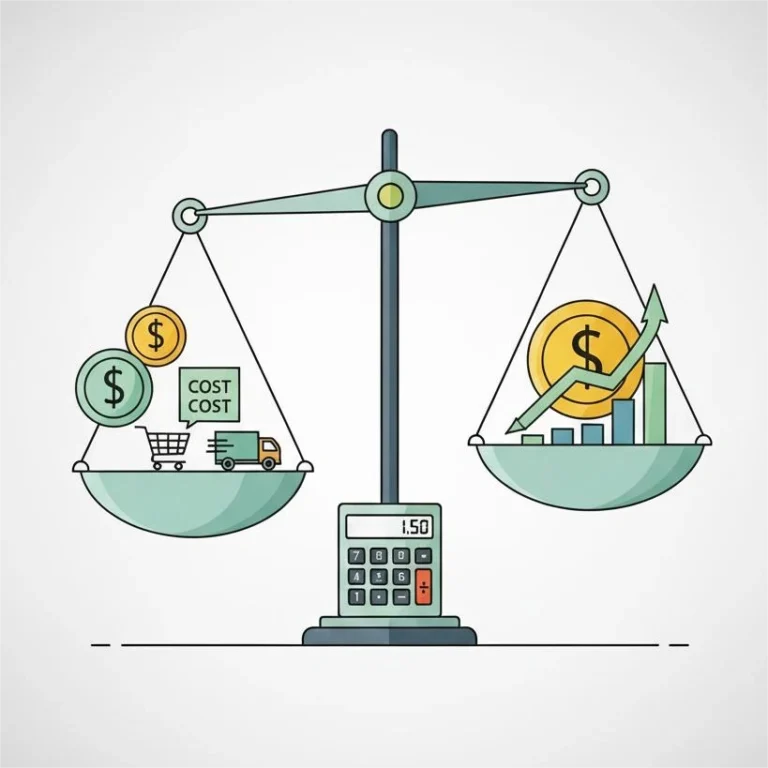
What is ROAS and Break-even ROAS?
ROAS, or Return on Ad Spend, measures how much revenue you earn for every dollar you spend on ads.
ROAS Fomula:
\( \displaystyle \mathrm{ROAS} = \frac{\text{Revenue}}{\text{Ad Spend}} \)
Example: If you spend $100 on ads and generate $400 in sales → ROAS = 400 ÷ 100 = 4. Higher ROAS → more profitable campaigns.
Calculate your ROAS.
Break-even ROAS tells you the minimum ROAS you need just to cover your product cost, shipping, and platform fees. If your ad campaigns deliver a ROAS below this number, you’re losing money. Anything above this number means you’re making a profit.
Break-even ROAS Fomula:
\( \displaystyle \text{Break-even ROAS} = \frac{\text{Selling Price}}{\text{Selling Price} - \text{Non-ad Costs}} \)
Example: Selling Price = $39.99, Non-ad Costs = $19.45 → Break-even ROAS ≈ 1.95. This means you need at least a 1.95 ROAS from ads just to break even.
FAQs
This tool calculates the minimum ROAS (Return on Ad Spend) you must achieve to avoid losing money.
It breaks down your non-ad costs (product cost, shipping, fees, misc expenses) and tells you the maximum ad spend you can afford before your product becomes unprofitable.
You only need a few basic numbers:
- Selling price
- Product cost
- Shipping cost
- Transaction fees
- Miscellaneous costs
The calculator automatically determines how much of the selling price is left to spend on ads—and how much ROAS you must maintain.
ROAS tells you how your ads are performing.
Break-even ROAS tells you the minimum performance needed to not lose money.
If your ROAS is:
Below break-even ROAS → you're losing money
Equal to break-even ROAS → breaking even
Above break-even ROAS → profitable
This benchmark determines whether a campaign should scale or be cut.
It depends on your margins, but generally:
1.0 ROAS → You only cover ad spend (not costs)
1.5 – 2.0 ROAS → Often break-even range
2.0 – 3.0 ROAS → Typically profitable
4.0+ ROAS → Strong performance and scalable
Your real goal is always:
👉 A ROAS higher than your break-even ROAS. Calculate your ROAS.
Lowering your break-even ROAS makes it easier to run profitable ads.
Try these strategies:
Reduce product cost by switching or negotiating suppliers
Optimize shipping to lower fulfillment costs
Increase your selling price or adjust pricing psychology
Improve conversion rate to reduce ad waste
Add upsells / bundles to increase AOV
Reduce transaction fees (e.g., switch payment processors)
Even small improvements can significantly reduce your break-even ROAS.
Not yet.
You generally want a healthy buffer before scaling—ideally:
ROAS ≥ Break-even ROAS + 20–30% margin.
If you're just slightly above break-even, volatility can push the campaign into loss.
Because real stores have daily operational expenses, such as:
- App subscriptions
- Packaging
- Virtual assistant fees
- Fulfillment extras
Including them gives you a more realistic break-even ROAS, not an inflated one.