

How Much Does It Really Cost to Start a Dropshipping Business?
Many guides claim you can start dropshipping with “just a few hundred dollars.” Technically, you can launch a website cheaply—but if you want to test products properly, survive cash-flow challenges, and operate legally, the real dropshipping startup cost is significantly higher.
So, how much does it really cost to start a dropshipping business? Does dropshipping cost money beyond basic setup?
The answer goes beyond basic setup – it includes the true cost to create a dropshipping business, from payments to marketing. Payment processor holds, ad account restrictions, marketing, and refund risks all require proper budgeting. Without planning for these, even a profitable store can collapse in its first few months.
In this guide, we break down the dropshipping startup cost step by step—from Business Expenses to domains, from store platforms to automation dropshipping tools, marketing budgets, payment reserves, and refund buffers—giving you a realistic 3-month budget to launch smart in 2026.
1. Business Expenses (Legal & Compliance Setup)

To operate a compliant dropshipping business, you should meet basic legal and tax requirements. The exact obligations depend on your country, state, or region, but beginners can usually start with a low-cost structure and upgrade later as revenue grows.
Entrepreneurs starting dropshipping or as a side hustle don’t necessarily need to register a company initially. For example, in the US, they can choose Sole Proprietorship (in the UK, they can start with Sole Trader).
United States
– Minimum setup: Sole Proprietorship
- No formal state registration required in many states
- Report business income on your personal tax return
- EIN (Employer Identification Number): Free (via IRS)
- Local business license (if required): $0–$200
– More formal structure: LLC
| Item | Typical Cost | Notes |
|---|---|---|
| LLC filing fee | $50–$400+ | Varies by state |
| EIN(IRS) | Free | Individuals can apply online. |
| Annual state fees | $50–$300+/year | Some states require annual fees/reporting fees |
| Accounting / tax services | $300–$1,500+/year | Depend on the size of your business and the professional |
You may also need to register for sales tax if you trigger economic nexus in certain states.
United Kingdom
– Minimum setup: Sole Trader
- Register for Self-Assessment with HMRC (Free)
- Report income and pay tax on net profits
– Limited Company (Ltd)
| Item | Typical Cost (GBP) | Notes |
|---|---|---|
| Company registration (Ltd) | ~£50–£100 | Online registration typically around £50 |
| Accounting / company secretary | £200–£600+/year | If outsourced |
| Annual confirmation statement & filings | £0–£150+ | Required yearly compliance filings |
Additional obligations:
- VAT registration is mandatory if annual taxable turnover exceeds £90,000.
- Corporation tax applies to company profits and must be filed annually.
Learn more about UK dropshipping.
Beginner Budget Estimate
For a lean startup phase, you can budget:
- $0–$200 (US Sole Proprietor)
- £0 (UK Sole Trader)
- Amount depending on your country or region
Formal structures (LLC/Ltd) increase credibility and liability protection but are not strictly required for initial product testing.
Compliance is not your largest startup expense — but ignoring it can create costly issues later.
2. Domain and Store Setup Costs (Fundamental Dropshipping Business Costs)
Domain Registration Cost
A domain name is essential for a shop and brand. Generally, .com is the preferred choice for businesses registering domains.
Regarding registration fees, many new website owners focus solely on the low price for the first year when choosing a domain. While it’s true that domain registration can be for under $10, or even as low as $0.01, these low initial prices often mask the higher renewal costs in the second year.
The actual cost of domain registration includes the initial purchase price and the long-term renewal fees payable each year. If you intend to operate long-term, you should also consider renewal costs when choosing a registrar.
| Registrar | Registration Cost (1st year) | Domain Renew Cost (2nd year) | Special Offer |
|---|---|---|---|
| GoDaddy | $4.99 | $22.99 | $45.99 for 3 years |
| NameCheap | $11.28 | $14.98 | |
| Bluehost | $12.99 | $12.99 | |
| Hostinger | $0.01 | $19.99 | |
| Dynadot | $10.88 | $10.88 | |
| Cloudflare | $10.46 | $10.46 |
Store Platform Cost
Your store platform is your fixed monthly infrastructure cost for a dropshipping business. For beginners, the key consideration is not just price, but ease of setup, maintenance complexity, and scalability.
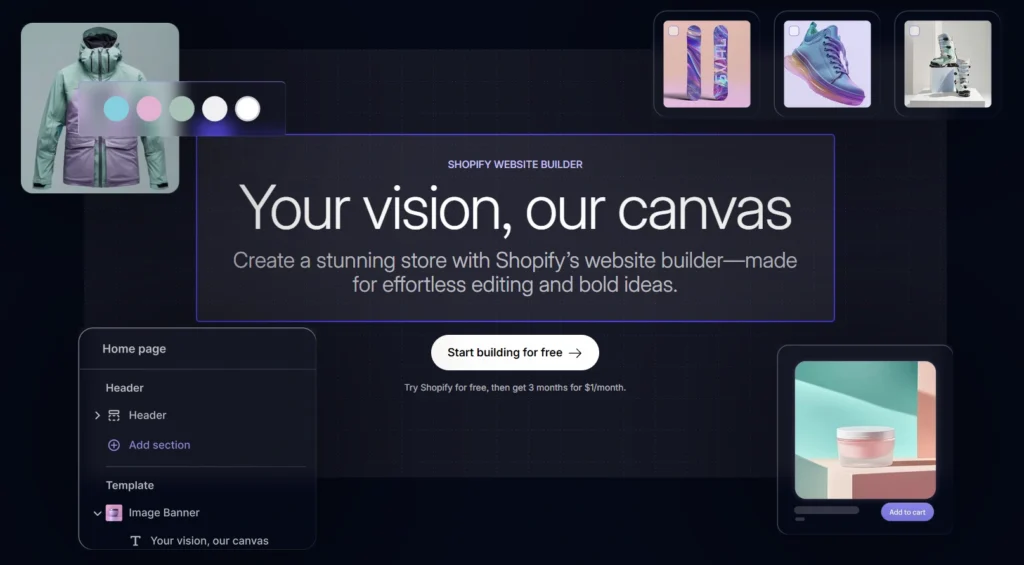
(1) Shopify (Most Beginner-Friendly)
- Basic Plan: $39/month
- Annual billing: $29/month
- Intro offer: $1/month for first 3 months
Shopify is the most popular choice for beginners because it is fully hosted, requires no technical setup, and includes built-in payment integration, security, and app ecosystem. This is usually the simplest and safest option for first-time sellers.
(2) Alternatives to Shopify
Wix
- Core Plan $29/mo (Discounted Price $14.5/mo)
Wix is another simple website builder option. It is easy to use and visually intuitive, but its ecommerce ecosystem is smaller than Shopify’s. Suitable for simple stores with fewer integrations.
Ecwid
- Venture Plan $35/mo ($29/month billed annually)
Ecwid works well if you want to add ecommerce functionality to an existing website. It is less commonly used for standalone dropshipping stores.
(3) WooCommerce
- Plugin cost: $0/month
- However, you must pay for:
- Web hosting
- Domain (Web hosting usually offer free domain for 1st year)
- Premium plugins (if needed)
- Theme (optional)
WooCommerce offers full control but requires technical setup and maintenance.
WordPress Hosting Options
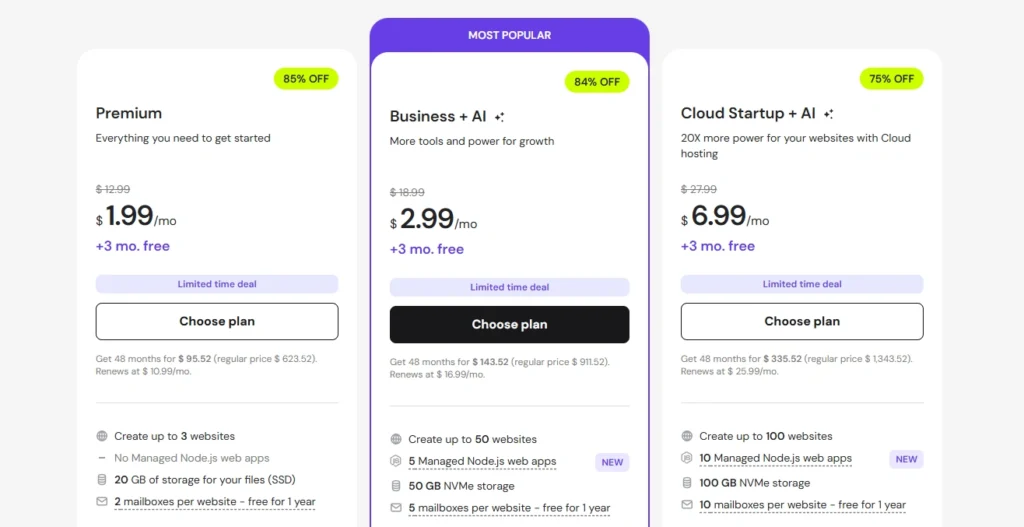
| Web Hosting | Starting Price | Special Notes |
|---|---|---|
| Hostinger | $1.99/month | $ 95.52 for 4 years; Free domain for 1 year |
| Cloudways | $14/month | Basic Serve Type; Cloud Provider Digital Ocean; 3-Day Free Trial |
| SiteGround | $2.99/month | Prepaid for 12 months. Renews at $17.99/mo. |
| GoDaddy | $10.99/month | Prepaid for 12 months. Renews at $239.88/yr |
| NameCheap | $9.88/month | EasyWP Starter; 1st month free trial; Renews at $9.88/mo; |
Important for beginners:
While WooCommerce looks cheaper upfront, total costs can increase once you add paid themes, page builders, payment plugins, or security tools. It also requires ongoing technical management.
If you are launching your first dropshipping store, a hosted solution like Shopify reduces operational risk and setup time.
3. Dropshipping Supplier & Automation Tool Costs
This is part of the ongoing dropshipping costs that scale with your operations. Starting a dropshipping business, choosing the right supplier and automation tools is paramount, as it directly impacts your order processing efficiency, product sourcing quality, brand building capabilities, and long-term scalability. For beginners, this often means paying a monthly subscription fee—but the real value lies in operational stability and fulfillment reliability.
The table below is based on common market options and leading Chinese dropshipping providers (you can also view more providers in the industry). If you prefer a leading Chinese dropshipping provider with zero subscription fees, consider ShipToTheMoon.
| Supplier/Platform | Pricing | Features |
|---|---|---|
| Zendrop | $79/mo | Top Winning Products; Zendrop Academy |
| AutoDS* | $14.9/mo | Pricing varies by platform; Generate a fully-built store; 800M+ bestselling products |
| DSers | $19.9/mo | Advanced Plan; 14 days free trial |
| USADrop | $19.99/mo | Pro Plan; Discount; Winning Products; Custom Branding |
| Ship To The Moon | 0 | Custom Branding; Sourcing; Automated Fulfillment |
* AutoDS automates the most time-consuming parts of dropshipping: product importing, price monitoring, inventory sync, and order fulfillment. For a beginner in their first 3 months, automation in these areas directly reduces operational costs by eliminating the manual work that would otherwise eat into margins or require outsourcing.
4. Marketing Costs (The Largest Expense)
When people ask, “How much does it cost to start a dropshipping business?” they often focus on platform fees or product samples. In reality, marketing is the largest – and most decisive – part of your dropshipping startup cost
This is why many beginners underestimate how much it cost to start dropshipping successfully. For a lean dropshipping launch, marketing is not simply promotion. It is the process of buying data to validate product–market fit. Without sufficient budget, you are not testing – you are guessing.
(1) Paid Advertising (Core Testing Expense)
Most beginners rely on paid traffic channels such as:
- Facebook Ads
- TikTok Ads
- Google Shopping Ads
Paid ads are the fastest way to test demand, pricing sensitivity, and conversion performance. At the testing stage, you are not scaling — you are collecting data. As long as a single ads campaign can break even, the product itself can be profitable; this requires calculating the minimum Return on Ad Spend.
(2) Creative Production (Conversion Driver)
Ad performance depends heavily on creative quality. Without compelling visuals and messaging, traffic will not convert.
Creative options for beginners:
- DIY filming (lowest cost: $0–$50)
- Entry-level UGC creators via freelance platforms ($50–$150 per video)
- Micro-influencer collaborations (lower sponsorship rates)
For early-stage testing, budget at least $100–$300 for creatives. Poor creatives distort test results and waste ad spend.
(3) Marketing Tools (Optimization Infrastructure)
Traffic alone does not guarantee profitability. Conversion rate optimization, retention, and data accuracy require supporting tools.
- Email & SMS Marketing: Klaviyo、Omnisend、Mailchimp ($20-$45/month)
- Conversion Rate Optimization (CRO): ReConvert, Judge.me, LOOX ($0-$35/month)
- Analytics & Attribution: Google Analytics (Free), Triple Whale ($99–$300/month)
- SEO Tools: Yoast SEO (~$19/month)
A lean setup may cost around $50–$100/month, depending on stack selection.
(4) Testing Buffer
In practice, many beginners try to offset dropshipping costs by testing low cost high profit products, but without proper data, even these items can fail. Product testing is probabilistic. You may test 10 products and only 1 becomes scalable. Without reserve capital, a single failed test can prematurely end your launch cycle. Maintaining a $100–$300 buffer allows you to: continue testing, iterate on ideas, and retest promising products after a failure.
This prevents abandoning potentially profitable products too early.
Minimum Viable Marketing Budget (3-Month Testing Phase)
| Category | Lowest Budget | Healthier Budget | Notes |
|---|---|---|---|
| Paid ads | $400–$600 | $800–$1,500 | Minimum Testing Structure: 1–2 products , 2–3 ad creatives per product, $20–$30 per day, 5–7 days of testing |
| Creatives | $100 | $300+ | Budget Estimate: DIY filming: $0–$50, Basic UGC video: $50–$150, Multiple creatives: $150–$300 |
| Tools | $100 | $100-$200 | Email marketing, conversion rate optimization, data analysis, SEO, etc. |
| Buffer | $100 | $300+ | As reserve funds for product testing |
| Total | ~$1,000 | $2,000+ |
5. Payment Processor Holds & Cash Flow Requirements
One cost that beginners often overlook in dropshipping is the cash-flow impact of payment holds and rolling reserves imposed by payment processors. Providers like Stripe, PayPal, and Shopify (via Shopify Payments) may delay payouts for new or higher-risk accounts. This can mean 7–21 day rolling holds, partial reserves (e.g., 5–20% of revenue), or in some cases extended freezes during reviews.
For a dropshipping store that must prepay suppliers and continuously fund ads, delayed access to revenue can create serious liquidity pressure—even if the business is technically profitable. For example, if you spend $200 per day on ads and payouts are delayed for 21 days, you may need over $4,000 in working capital just to sustain operations.
New sellers should therefore budget not only for marketing and store setup, but also for at least 2–4 weeks of operating cash to absorb potential payout delays. Cash flow—not just profit margin—often determines whether a new dropshipping business survives its first months.
6. Refunds, Returns & Hidden Profit Killers
Another frequently underestimated cost in dropshipping is the impact of returns and refunds on unit economics. In established eCommerce markets such as the US and UK, average online return rates typically range from 15–20%, and can exceed 25% in categories like apparel. While general retail data (e.g., industry reports from the National Retail Federation) often cite return-related losses as a significant percentage of revenue, the effect can be even more severe in cross-border dropshipping.
In many cases, sellers issue “refund without return” resolutions because international reverse logistics are too expensive, meaning the product cost, payment processing fee, and original advertising spend are all unrecoverable. For example, if a $50 product carries $20 in product cost and $15 in advertising cost, a single refunded order can erase far more than just the gross margin—it can generate a net loss. A 15% refund rate can reduce effective profit margins by half or more, depending on acquisition costs.
For this reason, beginners should incorporate a conservative refund-rate assumption (e.g., 10–15%) into their break-even ROAS and CPA calculations from the outset. Returns are not merely a customer service issue; they are a core startup cost variable that directly affects cash flow, profitability, and long-term account stability with payment processors.
7. Realistic 3-Month Total Startup Cost Estimate
Now that we’ve broken down each component of the dropshipping startup cost—from legal setup and store infrastructure to marketing, payment reserves, and refund risk—let’s consolidate everything into a realistic three-month launch budget.
At this stage, the real question is no longer “Can I start cheaply?” but rather:
How much capital do I need to test properly and survive the first 90 days?
Because in dropshipping, the first three months are not about profit. They are about:
- Testing multiple products
- Collecting statistically meaningful ad data
- Absorbing payout delays
- Managing refund volatility
- Keeping operations stable while learning
Below are two realistic budget scenarios.
Scenario A: Lean but Operationally Realistic (~$3,500–$4,000)
This assumes:
- Sole proprietor / sole trader setup
- Basic Shopify plan
- Mid-range automation tool
- Conservative marketing budget
- Minimum viable refund and cash-flow buffers
Estimated 3-Month Breakdown:
- Domain: ~$12
- Store platform (Shopify): ~$87 (Special offer $1/mo for the first 3 months)
- Automation tool: ~$75 (e.g., AutoDS)
- Marketing tools: ~$150
- Paid ads & creatives: ~$1,350
- Legal/registration buffer: ~$100
- Refund reserve: ~$500
- Cash-flow buffer (for payout delays): ~$1,500
Total: ≈ $3,500–$4,000
This is the minimum range where you can test products seriously without immediately running into liquidity pressure.
Scenario B: Healthier Testing & Scaling Position (~$7,000–$8,000)
This assumes:
- Stronger marketing push
- Multiple product tests
- Higher ad spend velocity
- Larger safety margin for refunds and reserves
Estimated Allocation:
- Fixed operational costs: ~$300–$400
- Marketing budget: $3,000+
- Refund reserve: ~$1,000
- Cash-flow buffer: ~$3,000
Total: ≈ $7,000–$8,000
This level of capital gives you room to:
- Test aggressively
- Recover from account restrictions
- Navigate 2–3 week payout holds
- Survive a failed product cycle
What This Really Means
Yes, you can technically launch a dropshipping store for under $500. But that is far from the realistic dropshipping business cost required to survive.
But if you are asking, “How much does it really cost to start a dropshipping business?”—the honest answer depends on whether you are budgeting for survival or just for setup.
Dropshipping is not a high fixed-cost business. It is a cash-flow sensitive, risk-managed business model.
The entrepreneurs who make it through the first 90 days are not necessarily the ones who spend the most — but they are the ones who budget realistically, protect liquidity, and plan for volatility.
And that, more than anything else, determines whether your store scales — or stalls.
FAQ
-
How much does it cost to start a dropshipping business in 2026?
A realistic dropshipping startup budget in 2026 ranges from $3,500 to $8,000 for a 3-month testing period. This includes platform fees, marketing costs, automation tools, refund buffers, and working capital for payment processor holds.
-
Can I start dropshipping with $500?
Technically yes, but $500 is typically insufficient for proper product testing. Most of that budget would be consumed by advertising, leaving little room for refunds, payment holds, or scaling.
-
What is the biggest cost in dropshipping?
Marketing and paid advertising are the largest costs. Product testing requires sufficient ad spend to collect meaningful data. Insufficient budget often leads to premature conclusions about product performance.
-
Do payment processors hold money in dropshipping?
Yes. Payment providers may impose 7–21 day payout delays or rolling reserves, especially for new accounts. Sellers should maintain sufficient working capital to avoid cash-flow issues.
-
How do refunds affect dropshipping profit?
Refund rates of 10–20% can significantly reduce effective profit margins because advertising cost, product cost, and payment fees are often unrecoverable. Refund assumptions must be included in break-even calculations.