

A fast-growing niche meets a regulatory wall
Seed dropshipping in the United States has quietly ridden the same wave that lifted the broader e-commerce economy: low barriers to entry, global sourcing, and a surge in home gardening. What was once a niche has turned into a meaningful subcategory within the “garden & DIY” segment—now one of the largest contributors to global dropshipping revenue.
But in 2026, the tone has shifted.
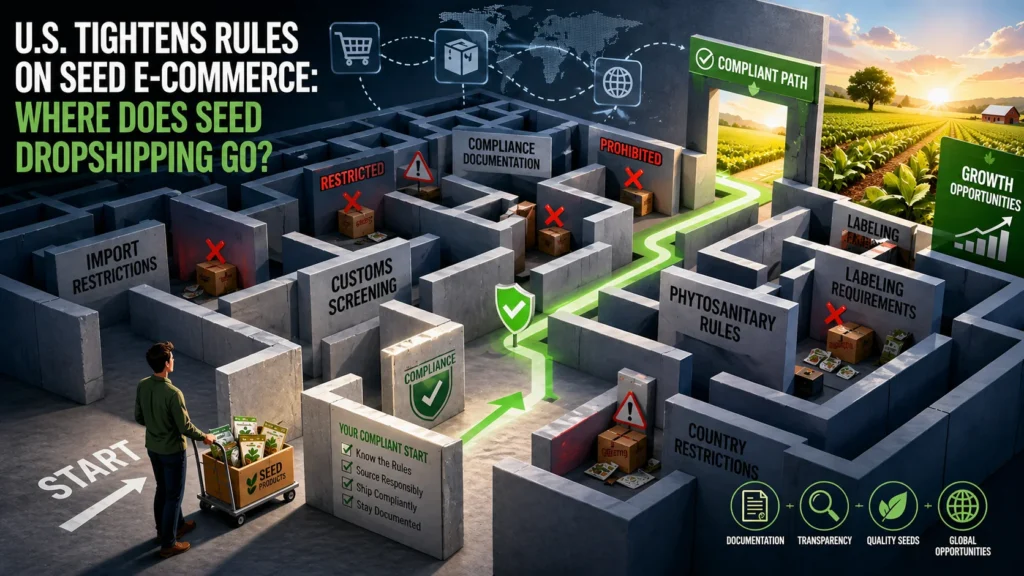
Behind the steady growth numbers, U.S. regulators are tightening enforcement on what crosses the border—and seeds, unlike most consumer goods, sit at the intersection of commerce, agriculture, and biosecurity. That makes them fundamentally different from T-shirts or phone cases. And it’s forcing a reset for how the entire category operates.
Why seeds are not just another SKU
At the center of the shift is a simple reality: seeds are regulated biological material.
The U.S. Department of Agriculture’s Animal and Plant Health Inspection Service (APHIS) treats most seeds as potential carriers of pests, pathogens, or invasive species. Import requirements—such as PPQ 587 permits or the “Small Lots of Seed” program—have existed for years, but enforcement has become more visible and more consistent.
At the same time, the Federal Seed Act requires accurate labeling for any seeds sold across state lines, including germination rates and purity standards. That means compliance doesn’t stop at the border—it continues all the way to the consumer.
For dropshippers used to frictionless cross-border fulfillment, this creates a structural mismatch.
The “easy model” is breaking down
For years, many sellers relied on a familiar playbook: source cheaply overseas, list aggressively on marketplaces, and ship directly to U.S. consumers in small parcels.
That model is now under pressure from three directions:
1. Increased inspection and enforcement
Low-value international packages, once lightly scrutinized – are now more likely to be flagged, especially when labeled ambiguously.
2. Consumer trust erosion
Cases of “mystery seeds” and fake listings (think “blue strawberries” or impossible hybrid plants) have made buyers more cautious.
3. Platform tightening
Marketplaces like Amazon and Etsy are quietly raising the bar for seed sellers, particularly around documentation and product authenticity.
The result: what used to be a low-friction category is becoming a high-compliance one.
The shadow of the “mystery seed” incidents
The turning point for many regulators and consumers alike came with the wave of unsolicited seed packages reported across multiple U.S. states starting in 2020, and still surfacing in variations through 2025.
Often linked to brushing scams (where sellers ship cheap goods to generate fake reviews), these packages raised a more serious concern: what exactly was entering the U.S. ecosystem?
Officials warned that such seeds could introduce invasive species, plant diseases, or unauthorized chemical treatments. Even when the intent was commercial manipulation rather than sabotage, the risk profile was undeniable.
For the seed dropshipping sector, the reputational damage has lingered. The category is now viewed through a stricter lens by regulators, platforms, and increasingly, consumers.
A quiet shift toward localization
While cross-border models face friction, another trend is gaining ground: localized dropshipping.
Instead of shipping directly from overseas suppliers, more sellers are partnering with U.S.-based warehouses or domestic seed companies. The advantages are clear:
- Faster delivery (often 3–6 days instead of weeks)
- Built-in compliance alignment with U.S. regulations
- Stronger consumer trust, especially with “U.S.-fulfilled” labeling
This shift mirrors broader changes across e-commerce, but in the seed category, it’s less about convenience and more about survival.
The new competitive edge: trust, not just price
Margins in dropshipping have always been tight, typically ranging from 10% to 30%. In seeds, that pressure is even more pronounced due to commoditization and seasonality.
So what’s changing in 2026?
The winners are no longer those who list the most products, but those who build credibility:
- Clear origin and labeling
- Verified germination standards
- Educational content (planting guides, climate zones)
- Niche positioning (organic, heirloom, region-specific seeds)
In other words, the business is moving closer to branding—and further from arbitrage.
What 2026 demands from seed dropshippers
If the past decade was about access, the next phase is about discipline. Based on current trends, three strategic shifts stand out:
1. From global sourcing to compliant sourcing
Sellers need to rethink supplier relationships entirely.
That doesn’t necessarily mean abandoning international sourcing, but it does mean ensuring that products can legally and reliably enter the U.S. system. For many, the practical solution is hybrid:
- Source globally
- Fulfill locally
2. From product listing to curated selection
The “list everything” approach is fading. Successful operators are narrowing their catalogs and focusing on:
- High-demand seed types (herbs, vegetables, pollinator-friendly plants)
- Regionally relevant varieties
- Seasonal planning
Curation is becoming a competitive advantage.
3. From anonymous stores to brand signals
Consumers are asking basic but powerful questions:
- Where are these seeds from?
- Will they actually grow?
- Can I trust this seller?
Answering those questions—visibly—can be the difference between conversion and abandonment.
Where Ship To The Moon fits into the shift
For sellers navigating this transition, the challenge isn’t just understanding the rules, it’s operationalizing them.
That’s where platforms like Ship To The Moon naturally come into play, not as a workaround, but as part of a more sustainable model:
- Connecting sellers with U.S.-based fulfillment infrastructure
- Supporting faster, compliant delivery workflows
- Enabling a shift from experimental selling to structured scaling
In a category where trust and compliance are becoming core assets, infrastructure decisions are no longer backend details, they are part of the brand itself.
Learn more about seed dropshipping of US super product line of Ship To The Moon.
A category at a crossroads
Seed dropshipping in the U.S. isn’t disappearing. If anything, demand remains strong, driven by sustainability trends, home gardening, and a growing interest in food independence.
But the rules of the game are changing.
The low-barrier era defined by cheap sourcing and minimal oversight, is giving way to a more complex environment where regulation, reputation, and reliability all matter.
For some sellers, that shift will feel like a constraint.
For others, it’s a filter – one that removes noise and rewards those willing to build something more durable.