


For years, Printful has been one of the safest answers in print-on-demand.
Reliable quality. Strong Shopify integration. Local fulfillment across North America and Europe. A polished onboarding experience that helped thousands of creators launch apparel brands without touching inventory.
And honestly, that reputation is deserved.
But the ecommerce landscape in 2026 looks very different from the one Printful helped pioneer.
Margins are tighter. Customer acquisition costs are higher. TikTok trends move faster than traditional POD production cycles. Sellers increasingly want more than just printed T-shirts. They want sourcing flexibility, hybrid fulfillment, custom packaging, private-label products, and supply chains that can evolve as quickly as the market does.
That shift is exactly why more sellers are searching for a serious Printful alternative — not necessarily because Printful is failing, but because their businesses are changing.
And that’s where Ship To The Moon enters the conversation.
Rather than operating as a pure POD platform, Ship To The Moon sits somewhere between a sourcing partner, a fulfillment infrastructure provider, and a modern dropshipping operation built for flexibility first.
The difference sounds subtle on paper. Operationally, it changes almost everything.
Printful Built the Gold Standard for POD Infrastructure
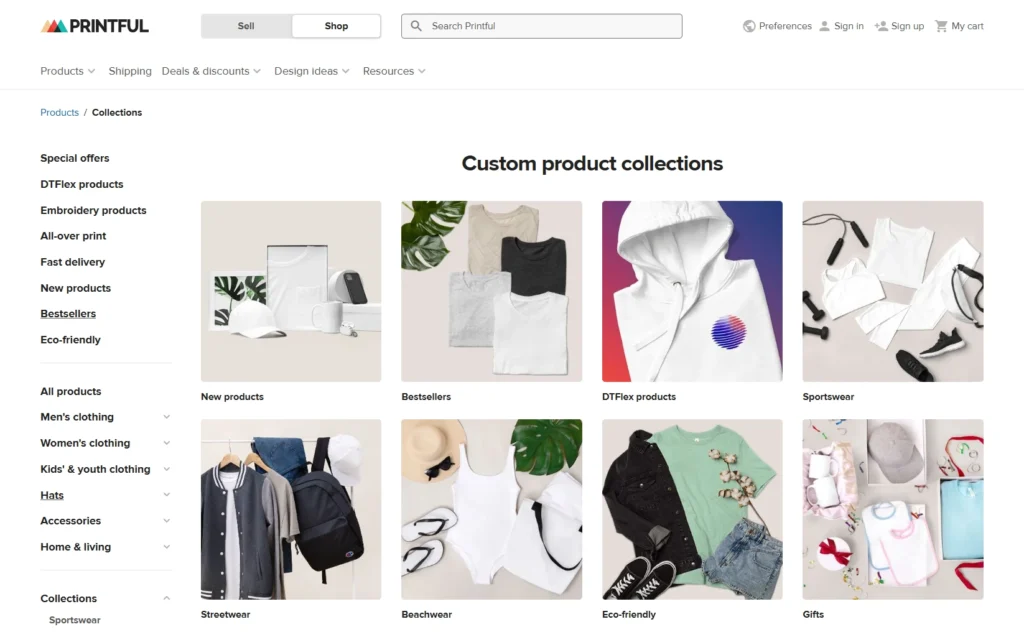
One reason Printful still dominates the conversation is simple: few companies invested as aggressively in vertical integration.
Unlike marketplace-style POD platforms that rely heavily on third-party print providers, Printful combines owned production facilities with regional fulfillment partners. That matters more than many beginners realize.
Consistency becomes easier to maintain when the same company controls production equipment, quality standards, routing logic, and branding workflows.
According to Printful’s published infrastructure data and fulfillment documentation, the company now operates a mix of owned facilities and regional partner fulfillment centers across North America, Europe, and selected Asia-Pacific markets. This localization strategy significantly reduces delivery times for Western markets while lowering cross-border friction.
For sellers targeting the US or Europe, that system works remarkably well.
Typical apparel production times still average around 2–5 business days, while local shipping often lands within another 2–5 days depending on destination and seasonality. Industry analyses in 2026 continue to show that localized fulfillment improves customer satisfaction metrics and reduces return-related friction, especially for Shopify and Etsy stores operating at scale.
That infrastructure advantage is difficult to replicate.
It’s also the reason Printful tends to attract a very specific type of seller:
- brand-focused apparel businesses
- creators building long-term lifestyle labels
- stores prioritizing consistency over experimentation
- merchants selling primarily into North America and Europe
For many of those brands, paying a slightly higher base product cost is a reasonable tradeoff.
Where Some Sellers Start Outgrowing Printful
The tension usually begins once a store expands beyond standard POD workflows.
A seller launches with printed hoodies or graphic tees. Sales grow. Then the business starts asking new questions.
- Can we source trending accessories outside the catalog?
- Can we bundle products together?
- Can we lower landed costs?
- Can we create custom packaging without enterprise-level minimums?
- Can we test faster-moving products from TikTok trends?
- Can we use overseas fulfillment for some SKUs and local warehousing for others?
This is where vertically integrated POD systems become less flexible.
Printful’s catalog is curated intentionally. That improves quality control, but it also limits sourcing freedom. Sellers can customize products inside the ecosystem, yet the ecosystem itself remains relatively controlled.
That structure is excellent for stability.
It’s less ideal for operators who treat ecommerce like an adaptive supply chain business.
Ship To The Moon Takes a Different Approach
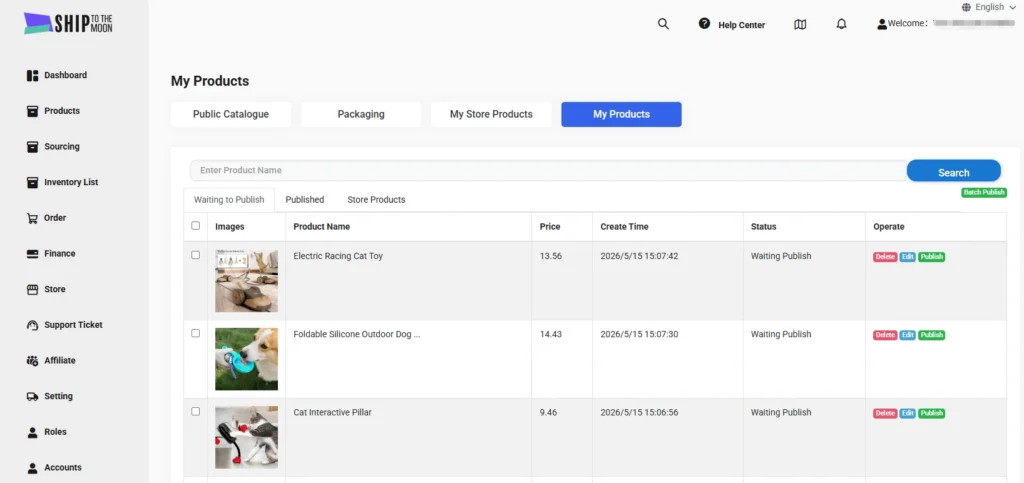
Ship To The Moon approaches ecommerce from the opposite direction.
Instead of starting with a fixed catalog and standardized production flow, the model revolves around flexible sourcing and fulfillment orchestration.
Part of that comes from its hybrid infrastructure.
Rather than relying exclusively on localized POD factories, Ship To The Moon combines:
- factory-connected sourcing in China
- private supplier relationships
- POD capabilities
- overseas warehouses
- agent-based product development
- custom packaging and branding support
That combination gives sellers something Printful intentionally limits: operational adaptability.
A store can launch a POD hoodie, test a trending pet accessory, source custom packaging, and move winning products into faster US warehouse fulfillment — all inside the same broader supply-chain ecosystem.
For modern ecommerce brands, especially those scaling through paid ads or social commerce, that flexibility matters more than it did five years ago.
Ship To The Moon vs Printful
Core Comparison Table
| Dimension | Ship To The Moon | Printful |
|---|---|---|
| Business Model | Hybrid dropshipping + sourcing + branding partner combining private supply chain access, sourcing agents, POD support, and flexible fulfillment. | Primarily a vertically integrated Print-on-Demand (POD) platform with in-house production and fulfillment infrastructure. |
| User Entry Flow | More consultative onboarding: sellers can test products, sourcing, shipping, or branding workflows before scaling long-term cooperation. | Self-serve onboarding. Sellers connect stores and start publishing POD products immediately. |
| Integration & Automation | Shopify, WooCommerce, Etsy integrations; API support for custom websites and automation workflows; supports automated order syncing, inventory updates, and tracking synchronization. | Supports Shopify, Etsy, WooCommerce, Amazon, Wix, Squarespace, eBay and 20+ major ecommerce platforms; mature API ecosystem and highly automated order routing. |
| Product Sourcing | Product marketplace + private supplier network + sourcing agent model. Supports custom sourcing, trending products, OEM/ODM requests, rapid sampling, and supplier negotiation. | Focused on its own curated POD catalog (500+ products). Strong apparel blank supply chain with brands like Bella+Canvas and Gildan, but limited third-party sourcing flexibility. |
| Product Flexibility | High flexibility. Products can be modified, bundled, customized, white-labeled, or developed around specific market trends. | Moderate. Strong for POD customization, but product development flexibility is constrained by Printful’s catalog. |
| Product Categories | Broader dropshipping coverage including consumer gadgets, beauty, pets, home, accessories, trending TikTok products, POD, and private-label products. | Mainly apparel, accessories, home decor, posters, drinkware, and POD lifestyle products. |
| Pricing Level | Factory-connected sourcing often results in lower base costs and wider profit margins, especially for scaling ads-driven ecommerce businesses. | Mid-to-premium pricing due to local production infrastructure and quality control. Better suited for higher-ticket branded positioning. |
| Profit Margin Potential | Generally higher margin potential due to direct sourcing and flexible supplier negotiation. | Typically lower gross margins but stronger perceived brand value and customer trust. |
| Product Compliance | Emphasizes compliant sourcing and lower-risk product selection; supports products with certifications like FDA, CE, FCC depending on category and supplier. | Strong compliance systems with sustainability certifications such as OEKO-TEX and GOTS; mature VAT/GST handling and IP protection tools. |
| Fulfillment Model | Flexible hybrid fulfillment using China direct shipping, private supply chains, and overseas warehouses depending on SKU and target market. | Vertically integrated fulfillment through Printful-owned or partner-operated production facilities with automated global routing. |
| Warehouse Network | Global warehouse coverage including China warehouses, US warehouses, and selected European fulfillment centers. | Extensive global production network across the the US, Europe, the UK, Canada, Mexico, Australia, Japan, and Brazil. |
| Shipping Speed | US warehouse orders can ship within 2–5 days domestically; China fulfillment typically delivers globally in 6–12 days depending on destination. | Localized production enables 2–5 day production plus fast domestic delivery in major markets. |
| Custom Branding | Supports custom packaging, logo printing, insert cards, bundled branding assets, and supplier-level packaging customization. | Advanced white-label branding: custom neck labels, pack-ins, branded packing tape, custom packing slips, and fully white-label shipments. |
| Print on Demand | Supports POD services but with greater sourcing flexibility beyond traditional POD categories. | Core strength. Industry-leading DTG, embroidery, AOP, sublimation, poster printing, and branded apparel production. |
| Scalability | Strong flexibility for testing, scaling, switching suppliers, and adapting to fast-moving ecommerce trends. | Extremely stable infrastructure for long-term POD brand scaling in North America and Europe. |
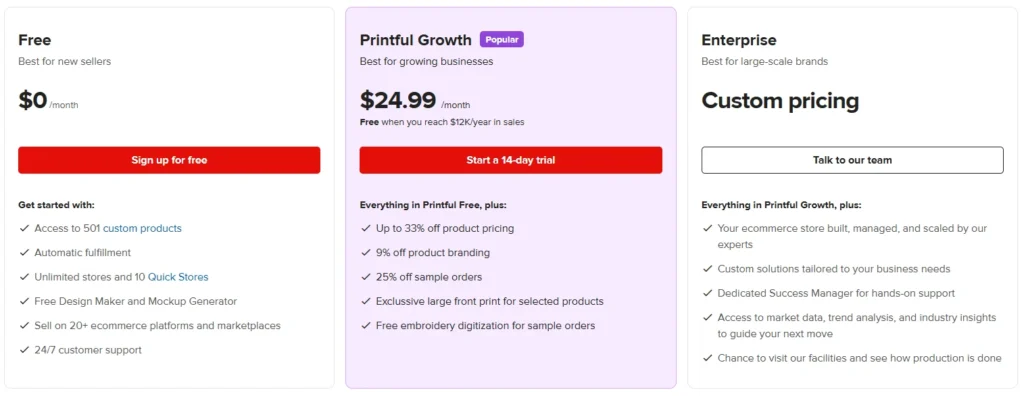
| Pricing Model | No subscription fee; primarily pay-per-order or custom quotation depending on sourcing and fulfillment requirements. | Freemium structure with optional subscription plans offering discounts and extra branding features. Printful Growth Plan: $24.99 /month (Free when you reach $12K/year in sales) |
| Hidden Costs | Generally transparent but more customized pricing means sellers may need to confirm sourcing, packaging, or shipping configurations case-by-case. | Transparent fee structure; additional costs may include embroidery digitization, warehousing, or branding add-ons. |
| Support | 1-on-1 account managers, fast communication, sourcing assistance, and operational support with English-speaking teams. | 24/7 multilingual support, live chat, onboarding resources, and dedicated account managers for larger merchants. |
| Education & Resources | Practical operational content including sourcing guides, ecommerce tutorials, fulfillment education, and supplier strategy support. | Strong educational ecosystem including Printful Academy, trend reports, tutorials, and branding-focused content. |
| Best For | Ecommerce sellers prioritizing flexibility, sourcing freedom, higher margins, trend responsiveness, and hybrid dropshipping/branding models. | Sellers building premium long-term POD brands with strong focus on product consistency, local fulfillment, and brand perception. |
| Main Trade-Off | Greater flexibility and profitability potential, but requires more supplier communication and operational decision-making. | Higher quality consistency and infrastructure, but less sourcing flexibility and usually higher product costs. |
The Margin Conversation Matters More in 2026
One of the most common frustrations inside the POD space today is shrinking profitability.
Ad costs have risen sharply across Meta and TikTok. Meanwhile, many POD base products remain relatively expensive due to local labor and production costs.
Printful’s own pricing structure reflects that reality.
For apparel, many stores ultimately land in the 20–25% net margin range after shipping and advertising costs. Home decor and wall art often perform better, but apparel remains the dominant category for most POD beginners.
That doesn’t make Printful overpriced. It reflects the economics of localized production.
But sellers running aggressive paid acquisition strategies often start looking for more sourcing leverage.
This is one reason hybrid models are growing so quickly in 2026.
With factory-connected sourcing and more flexible supplier negotiation, Ship To The Moon gives sellers additional room to optimize landed cost structure — particularly outside traditional POD apparel.
For operators scaling through TikTok Shop, impulse products, bundles, or trend cycles, that extra margin buffer can determine whether a campaign survives long enough to scale.
Branding: Printful Still Has an Advantage in POD Sophistication
This is important to say clearly.
Printful remains one of the strongest branding-focused POD platforms in the market.
Its inside labels, outside labels, branded pack-ins, custom packing slips, and white-label packaging workflows are genuinely mature. The company has spent years refining the “invisible supplier” experience that premium DTC brands care about.
For apparel-heavy brands, especially those trying to build long-term identity around consistency and perceived quality, that matters enormously.
Ship To The Moon supports custom packaging, insert cards, logo applications, and branding workflows too — but the positioning is different.
The emphasis is less about standardized POD branding systems and more about flexible customization across broader product categories.
That distinction matters depending on what kind of business you’re building.
If your store revolves around premium embroidered streetwear, Printful may still feel more specialized.
If your business constantly evolves product lines and tests new categories, flexibility may matter more than embroidery digitization workflows.
Fulfillment Speed Is No Longer a Simple “US vs China” Debate
Five years ago, sellers often treated China fulfillment as automatically slow.
That assumption is outdated.
The rise of overseas warehousing, regional logistics optimization, and hybrid fulfillment models has changed the equation substantially.
Printful still has an advantage for highly localized POD fulfillment in the US and Europe. That’s hard to dispute.
But modern hybrid suppliers now routinely combine:
- US warehouse inventory for winning SKUs
- China direct fulfillment for testing products
- flexible routing based on destination country
- regional stock allocation strategies
Ship To The Moon operates much closer to this newer model.
In practice, many sellers now separate products into two phases:
- test products through flexible sourcing
- move validated winners into faster warehouse fulfillment
Operationally, that workflow often produces better long-term economics than forcing every product through localized POD production from day one.
Why Experienced Sellers Often Move Beyond Pure POD
Something interesting has happened in ecommerce over the last two years.
Many successful POD sellers didn’t abandon POD entirely. They expanded beyond it.
A store that starts with graphic tees may eventually add:
- accessories
- pet products
- home decor
- bundles
- seasonal impulse products
- private-label items
- TikTok trend products
At that point, the business stops behaving like a simple POD store.
It becomes a supply-chain optimization business.
That’s where the difference between Printful and Ship To The Moon becomes much clearer.
Printful optimizes operational consistency.
Ship To The Moon optimizes operational flexibility.
Neither philosophy is objectively “better.” They solve different problems.
So, Which One Makes More Sense in 2026?
If your goal is to build a polished apparel brand with reliable POD fulfillment, strong branding consistency, and localized production in Western markets, Printful remains one of the safest infrastructure choices available.
There’s a reason serious Shopify apparel brands still use it.
But if your business model depends on testing products aggressively, protecting margins, adapting quickly to trends, or combining POD with broader ecommerce sourcing strategies, Ship To The Moon starts making a compelling case as a modern Printful alternative.
Especially in 2026, flexibility itself has become a competitive advantage.
And increasingly, sellers are optimizing for adaptability just as much as fulfillment quality.
Final Take
The most useful way to compare Printful and Ship To The Moon is not “which platform is better.”
It’s understanding what each platform was designed to optimize.
Printful was built to professionalize print-on-demand.
Ship To The Moon was built for sellers navigating a far more fluid ecommerce environment — one where sourcing, fulfillment, branding, logistics, and trend velocity increasingly overlap.
For some brands, stability wins.
For others, flexibility compounds faster.
The right answer depends less on the platform itself, and more on the kind of ecommerce business you’re trying to build.