

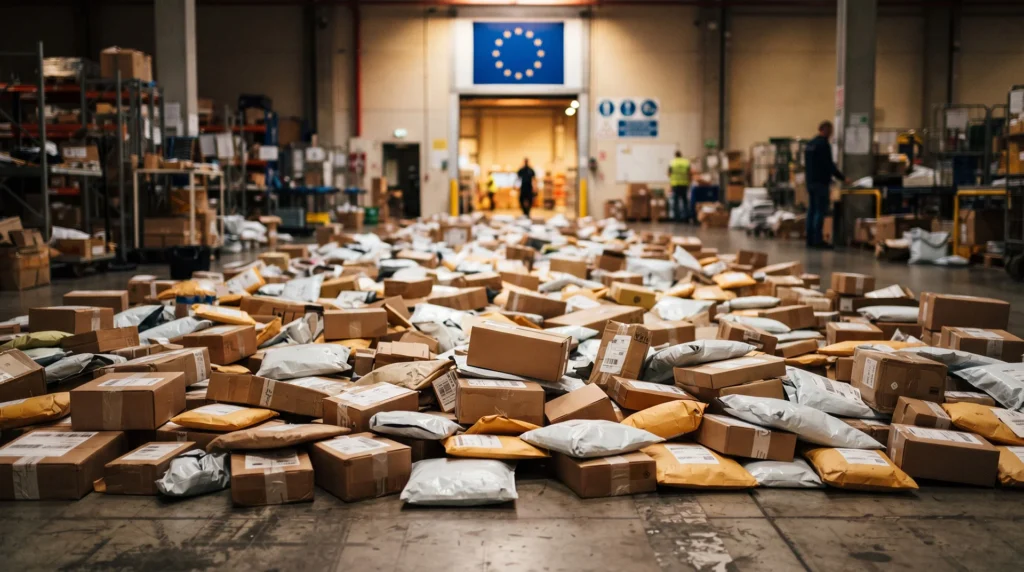
If you’ve been shipping low-cost products into the EU and quietly relying on the €150 duty-free threshold, that free ride is officially over. Council Regulation (EU) 2026/382 took effect on July 1, 2026, scrapping the exemption and replacing it with a flat €3 customs duty on nearly every low-value item entering the EU. It’s been live for a little over a week now, and the impact is already showing up in landed costs.
Here’s what changed, why it happened, and what to actually do about it.
Why the Free Ride Ended
Until June 30, 2026, any parcel shipped from outside the EU worth €150 or less could enter duty-free (VAT still applied, but customs duty didn’t). That loophole helped fuel an explosion in cross-border e-commerce — EU consumers imported roughly 4.6 billion low-value parcels in 2024 alone, more than triple the 2022 figure.
Brussels had seen enough. Regulators estimate up to 65% of these small parcels were undervalued to dodge duties in the first place. Add to that the U.S. shutting down its own $800 de minimis exemption back in August 2025, and the EU moved fast — worried that trade would simply redirect toward Europe. The Council adopted the regulation on February 11, 2026, and fast-tracked the start date to July 1.
What’s Actually Being Charged
The headline number: from July 1, 2026 through July 1, 2028, any imported item valued at €150 or less now gets hit with a flat €3 customs duty per item. This is a temporary bridge measure — once the EU’s Customs Data Hub goes live in 2028, it’ll be replaced by a full tiered duty system.
A few details that are easy to miss but will absolutely bite you if you skip them:
- It’s charged per item, not per parcel. If your parcel has multiple products under the same HS code, you pay one €3 fee. But if it contains, say, a silk top and two wool tops (different tariff sub-headings), that’s now two separate line items — €6, not €3. Multi-SKU orders can stack up fast.
- The €150 threshold is based on “intrinsic value” only. That means product price alone — shipping, insurance, and any separately itemized fees don’t count toward the cap.
- The seller pays, not the customer at the door. The €3 is charged to the seller, importer, or their representative — it won’t show up as a surprise COD charge for your buyer, but it will show up in your margins.
- Using IOSS doesn’t get you out of it. The duty applies regardless of whether you’re on IOSS, Special Arrangements, or standard VAT — there’s no VAT-scheme workaround here.
- Watch the free trade agreement trap. If your product qualifies for preferential FTA duty rates, you only keep that lower rate if you declare it through the standard H1 process without using IOSS for VAT. Run the exact same product through IOSS instead, and you lose the preferential rate and get hit with the flat €3.
And This Is Just the Opening Bill
The €3 duty is only layer one. The EU is expected to roll out an additional EU-wide handling fee of roughly €2 as early as autumn 2026. On top of that, individual member states — France, Italy, and Romania among them — are already layering on their own national handling fees. Stack all three together and a single dutiable line item could realistically hit €7 or more.
There’s also a data compliance piece coming: mandatory Product Identifier (PID) reporting kicks in November 1, 2026 (voluntary until then), which means vague catch-all listings like “accessories” are going to get flagged at customs a lot more often. On top of that, the Commission will run monthly monitoring starting October 2026 to catch sellers rerouting shipments to dodge the new duty — and has signaled it could widen the duty’s scope further if it sees evidence of that happening.
What This Means If You’re Dropshipping
This isn’t a minor cost bump — for a lot of dropshipping operations, it hits the actual foundation of the business model:
- Low-ticket items take the biggest hit. The lower your price point, the bigger the percentage of your margin €3+ eats up. Some categories may simply stop being profitable at current pricing.
- HS classification accuracy is no longer optional. Get it wrong and you risk duplicate charges, customs delays, or worse — flagged shipments.
- The old undervaluing/splitting tricks are much riskier now. With monthly surveillance in place, the workarounds that used to fly under the radar are exactly what regulators are hunting for.
- Product data quality is now a bottleneck. From descriptions to PID codes, weak upstream data slows everything down at the border.
What To Do About It, Starting Now
Based on what we’re seeing across the industry, here’s where to focus:
- Rebuild your landed cost model. Bake the €3 duty — and the incoming handling fees — directly into your pricing. Figure out now which SKUs still hold a margin and which ones don’t.
- Shift toward higher-ticket, simpler-to-classify products. Instead of chasing volume on razor-thin-margin items, prioritize products with healthier margins, clean HS classification, and lower compliance risk.
- Clean up your supply chain data. Work with suppliers now on accurate descriptions, materials, and HS codes — you’ll need this before PID reporting becomes mandatory in November.
- Look into EU-based warehousing or bulk consolidation. Importing in bulk to a local warehouse and fulfilling from there can be more efficient than one-off duty calculations on every single parcel.
- Keep tracking the fee stack. The autumn EU handling fee and various national fees are still evolving — don’t let your cost model go stale the moment a new charge lands.
The direct-to-consumer, low-cost shipping model that defined the last few years of EU dropshipping is fading. That doesn’t mean the opportunity is gone — it means the field is narrowing to sellers who move fast on cost restructuring and compliance. Get ahead of it now, and you’re in a much stronger position than the competitors still pricing like it’s June.