

If you’re new to ecommerce, it’s common to feel confused by the terms ecommerce and dropshipping. Some people are familiar with ecommerce but have never tried dropshipping; others assume dropshipping is a completely different business altogether.
In reality, the distinction is much simpler.
Ecommerce is an umbrella term for selling products or services online. Dropshipping is just one way to fulfill ecommerce orders—specifically, without holding inventory yourself. Because it breaks away from the traditional “buy, store, then sell” model, dropshipping is often misunderstood and sometimes viewed with skepticism.
This article breaks down the differences between ecommerce and dropshipping, compares the pros and cons of each model, and helps you decide which approach makes the most sense for your business stage.
What Is Ecommerce?
Ecommerce (electronic commerce) refers to any business that sells products or services online. This includes sales through online marketplaces as well as independent online stores.
In a typical inventory-based ecommerce setup, sellers purchase or manufacture products, store inventory, sell through a website or platform, and manage logistics to deliver orders to customers.
Common Ecommerce Business Models
B2C (Business-to-Consumer)
Businesses sell directly to individual consumers through online stores or marketplaces. This describes who the transaction is between, not how fulfillment is handled.
B2B (Business-to-Business)
Businesses sell products to other businesses, often involving larger order volumes, longer sales cycles, and ongoing partnerships.
DTC (Direct-to-Consumer)
Brands sell directly to end customers through their own channels, bypassing distributors and retailers. DTC is often viewed as a more brand-driven evolution of B2C.
Platforms Used to Run Ecommerce Stores
Online Marketplaces (Amazon, eBay, Etsy)
Marketplaces offer built-in traffic, established trust, and integrated logistics. The tradeoff is limited control—sellers must follow strict platform rules and face account suspension risks.
Independent Stores (Shopify, WooCommerce)
Independent websites provide greater control over branding, pricing, and customer data. Merchants are responsible for traffic acquisition, operations, and fulfillment decisions.
How Inventory-Based Ecommerce Works
In inventory-based ecommerce, the seller typically manages:
- Product sourcing or manufacturing
- Inventory storage (warehouse or 3PL)
- Order packing and shipping
- Customer service and returns
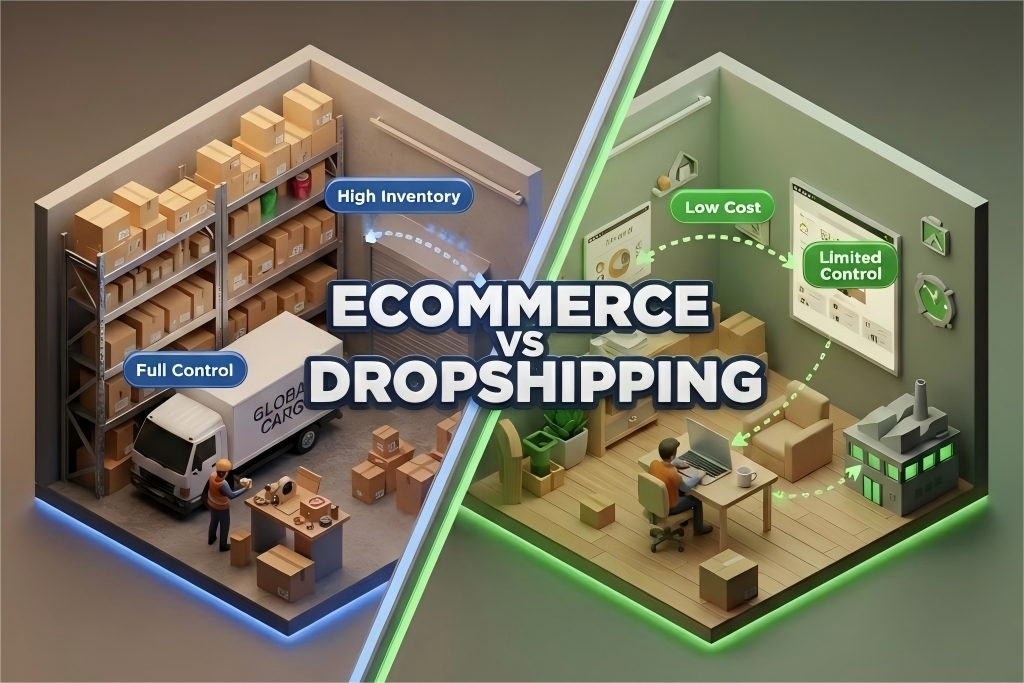
This model offers strong brand control and healthier margins at scale, but it requires higher upfront investment, operational expertise, and ongoing management—making it riskier for beginners.
What Is Dropshipping?

Dropshipping is a fulfillment method within ecommerce where the seller does not hold inventory. Instead, when a customer places an order, the seller forwards the order to a supplier, who ships the product directly to the customer.
This removes the need for inventory purchasing, warehousing, packaging, and shipping—significantly lowering upfront costs and operational complexity.
How Dropshipping Works
A typical dropshipping flow looks like this:
- You create an online store and list supplier products
- A customer places an order and pays you
- You forward the order details to the supplier and pay them
- The supplier ships the product directly to the customer
Your profit comes from the difference between your retail price and the supplier’s cost. A profit calculating tool can help you make clear all the costs and final profit rate.
Key Differences Between Ecommerce and Dropshipping
Although dropshipping is part of ecommerce, the two models differ significantly in cost structure, risk profile, and operational control.
1. Inventory Management: Stock vs. No Inventory
Inventory-based ecommerce requires purchasing products upfront and storing them in a warehouse or 3PL. For example, a home goods seller might need to buy several hundred units per SKU and rent 300–500 square feet of storage.
Dropshipping requires no inventory at all. Sellers can test multiple products quickly, making it easier to validate demand without tying up capital—especially valuable for new sellers.
2. Startup Costs: Higher Commitment vs. Low Barrier to Entry
Inventory-based ecommerce often requires a five-figure upfront investment, covering product costs, warehousing, logistics setup, and insurance.
Dropshipping usually starts with low four-figure costs, mainly for store setup, apps, and advertising. Because suppliers are paid after customers place orders, cash flow pressure is significantly lower.
3. Risk Profile: Inventory Risk vs. Supplier Dependence
Inventory-based sellers face the risk of unsold stock. Slow-moving inventory can tie up cash and force discounting.
Dropshipping avoids inventory risk but shifts exposure to the supply chain. Stockouts, shipping delays, or quality issues from suppliers can directly affect customer satisfaction and store ratings.
4. Profit Margins and Control
Inventory-based ecommerce benefits from bulk purchasing and cost optimization. As volume increases, unit costs drop, enabling healthier margins and custom packaging, inserts, and branding.
Dropshipping typically has thinner margins due to higher per-unit costs. Brand control is limited unless the seller later transitions to private labeling or custom fulfillment.
5. Logistics and Customer Experience
With local inventory, sellers can offer 2–3 day domestic shipping and consistent delivery performance.
Dropshipping logistics depend entirely on the supplier’s location and capabilities. International fulfillment often means 7–15 day delivery windows, limited tracking visibility, and higher risk of negative reviews as order volume scales.
Ecommerce vs. Dropshipping: Pros and Cons in Practice
To illustrate the difference, imagine two entrepreneurs in Austin—Maria and Jake—who both decide to sell pet slow-feeding bowls online.
Maria chooses inventory-based ecommerce. She invests about $18,000 to pre-order 3,000 bowls and rents a 200-square-foot storage unit.
Jake chooses dropshipping. He launches a Shopify store, connects to a supplier integration, and starts selling with zero inventory.
Three months later:
- Maria’s gross margin reaches 42%, but she still has 600 unsold pink bowls.
- Jake’s margin is only 22%, but by testing colors and features, he discovers that a non-slip base version converts best and scales it aggressively.
This contrast highlights the tradeoffs between the two models.
I. Inventory-Based Ecommerce
Advantages
- Higher Margins
Buying in bulk significantly lowers unit costs. - Stronger Brand Building
Custom packaging, inserts, and consistent presentation improve customer loyalty and social proof. - Predictable Logistics
Domestic shipping enables faster delivery and better control during peak seasons.
Disadvantages
- High Upfront Capital
Product costs, duties, storage deposits, and insurance are required before the first sale. - Inventory Risk
Unsold SKUs often require clearance pricing, directly reducing profitability. - Operational Complexity
Inventory forecasting, quality checks, insurance, and warehouse management add ongoing overhead. In hot climates, even temperature control can become a cost factor.
II. Dropshipping
Advantages
- Low Risk Testing
Products can be tested quickly with minimal financial exposure. - Fast Iteration
New SKUs can be launched or removed within days based on performance data. - Cash-Flow Friendly
Customer payments are received before supplier payouts, maintaining positive cash flow.
Disadvantages
- Thin Margins
Returns, payment disputes, and ad costs can compress net margins into single digits. - Limited Control Over Experience
Shipping delays or supplier issues directly impact reviews and ad account health. - High Competition
Popular products are easy to copy, often leading to price wars and short product lifecycles.
III. A Hybrid Approach: Test First, Scale Later
Many modern brands combine both models strategically:
- Months 1–3: Use dropshipping to test products and identify winners
- Months 4–6: Move bestsellers to small-batch inventory with custom packaging via a domestic 3PL
- Month 7+: Scale via bulk production and optimized logistics once demand is proven
This approach treats dropshipping as a testing lab and inventory-based ecommerce as a growth engine, avoiding both overstock risk and long-term margin limitations.
Final Thoughts
Choosing a fulfillment model is like choosing transportation. Dropshipping is a shared scooter—fast, flexible, and ideal for exploration. Inventory-based ecommerce is a pickup truck—more expensive to run, but capable of carrying a brand long-term.
What ultimately determines success isn’t the model itself, but how well you align product selection, marketing, fulfillment, and customer experience with your current stage and long-term goals.
The best businesses know when to ride the scooter—and when it’s time to buy the truck.
TL;DR: Ecommerce vs. Dropshipping
- Ecommerce refers to selling products or services online; dropshipping is a fulfillment method within ecommerce that does not require holding inventory.
- Inventory-based ecommerce involves upfront product purchasing, warehousing, and self-managed logistics, resulting in higher startup costs but greater control and margins.
- Dropshipping allows sellers to list products without pre-buying stock, offering lower financial risk, faster product testing, and simpler operations.
- The core differences lie in inventory ownership, capital requirements, risk exposure, profit margins, and logistics control.
- Inventory-based ecommerce is better suited for scaling, branding, and long-term profitability once demand is validated.
- Dropshipping is most effective for beginners or early-stage businesses focused on market validation.
- A hybrid strategy—testing products via dropshipping, then shifting proven SKUs to inventory-based fulfillment—balances risk and growth.