Launch your dropshipping journey today – Your first sale is closer than you think!



If you’re here wondering whether dropshipping is worth your time, money, and effort in 2026, you’ve asked the right question—but perhaps in the wrong direction.
The questions echo across discussion boards, group chats, and business forums:
“Is dropshipping dead?”
“Is Dropshipping worth it in 2026?”
“Can I still make money with a Shopify store?”
“Should I try dropshipping after seeing those success stories?”
But the real question isn’t whether dropshipping works in 2026—it’s whether it will work for you.
Let’s delve deeper into this.
Dropshipping in 2026: Market Reality

First, let’s clarify one point: dropshipping is not outdated. According to market projections, the global dropshipping industry is expected to grow at about a 22% compound annual growth rate from 2025 to 2030, potentially reaching $1.25 trillion globally by the end of the decade. That’s big.
Other industry data shows:
- Dropshipping is involved in roughly 23% of global online transactions.
- About 27% of online stores use dropshipping as their main fulfillment method.
- Most individual dropshippers report monthly earnings in the $1,000 to $5,000 range; it’s not an overnight fortune.
These figures make two things clear:
- The dropshipping model remains widely used and is still part of the e-commerce infrastructure.
- It’s not a shortcut to wealth, but a business model.
Why Simple “Dropshipping Works” Answers Are Misleading
Too many discussions boil down to one of two extremes:
- “Dropshipping is saturated / dead.”
- “If you just build a Shopify store and run ads, you’ll make bank.”
Neither tells you anything useful about your situation. Believing either one would be misleading. Because things have changed since “Easy Dropshipping Days”:
1. Competition and costs are higher
Platforms like Facebook, Instagram, and Google are flooded with merchants competing for attention. According to recent e-commerce data, the average cost per click (CPC) for dropshipping ads has risen by more than 60% since 2020. With AI-driven bidding and increasing competition, that trend is expected to continue.
If CPC goes up but your profit margin stays the same, you either make less per sale—or you need to rethink your economics entirely.
2. Customers have more options and higher expectations
Shoppers have grown accustomed to fast delivery, reliable returns, trusted reviews, and well-known brands. It’s difficult for an ordinary store selling the same products as Amazon or Temu to win customer trust and loyalty.
3. The “Easy Money” Narrative Is Over
Success used to be framed as:
Create a store → Run ads → Profit
In 2026, that story is simply not how successful operators work. People who are still building sustainable businesses treat dropshipping as a fulfillment method, not a magic money-making tool.
The Hard Truth: It’s Not About the Model—It’s About Execution
Anyone can set up a “Buy Now” button and run ads; countless tools can help you do it. What most people overlook is that even in 2026, dropshipping still requires real business skills, which these online platforms can’t provide:
- Robust product economics
- Reliable fulfillment logistics
- Branding and customer trust
- Thoughtful ad strategy and data analysis
Success isn’t about luck or shortcuts, but about repeatedly making better decisions.
As one experienced operator put it:
“Dropshipping isn’t a business model—it’s a fulfillment method. Customers don’t care where something ships from; they care if it arrives fast, matches the photos, and they can return it without a headache.”
Another candid takeaway:
“If you think this is a get-rich-quick scheme, quit immediately. It takes perseverance, testing, and patience—just like any other business.”
What People Really Mean by “Is It Worth It?”

When experienced founders talk about dropshipping in 2026, they’re usually not asking:
- “Does it work in principle?”
- “Has it ever made money?”
They’re asking:
“Can I make this work for me given my real skills, budget, and goals?”
And that’s the question that actually matters.
Before You Spend Time or Money: Assess Your Readiness
Reading articles, watching videos, and gathering knowledge are helpful—but they don’t answer the crucial question:
Do you personally have the conditions to turn dropshipping into a sustainable business?
For many people, the missing step isn’t understanding the theory—it’s understanding where they stand right now in terms of:
- Resources
- Skills
- Execution capability
- Risk tolerance
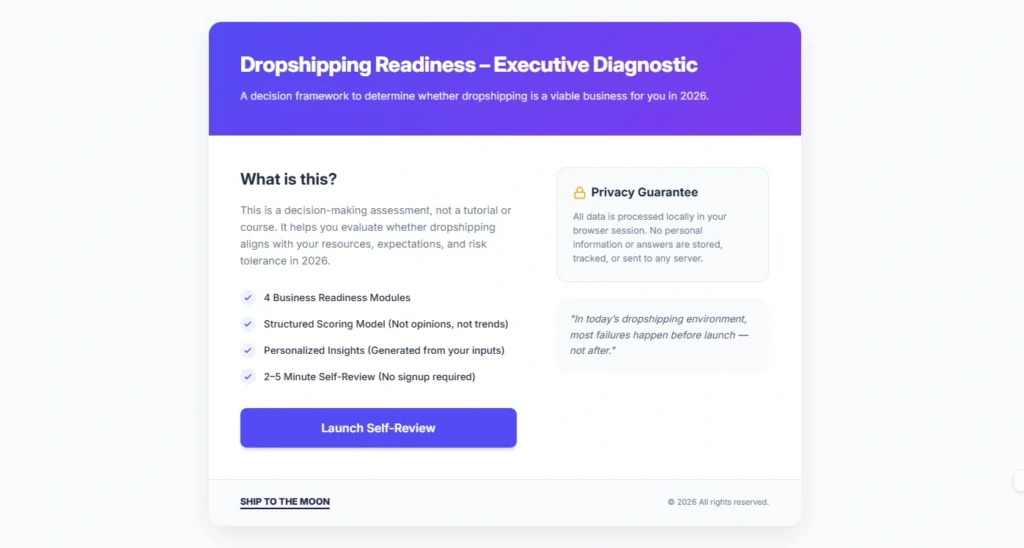
That’s why we built a 2-minute Readiness Diagnostic that gives you:
- An instant score
- A personalized verdict
- A clear view of your strongest and weakest areas
- Practical guidance on what to do next
Dropshipping Readiness Diagnostic Tool
(No signup required — instant results and privacy guarantee)
Who Is Most Likely to Succeed in Dropshipping Today
Based on industry trends and experiential insights, dropshipping tends to work best for people who:
- Understand unit economics and logistics costs
- Can handle data-driven ad testing
- Think like business operators, not opportunistic marketers
- Are willing to do the grunt work of learning and optimization
Those who treat dropshipping as a business discipline, not a shortcut, tend to have the best outcomes.
But if you’re entering the space hoping to “set up and profit” with minimal effort? You’re likely setting yourself up for frustration, not success.
Common Myths About Dropshipping (Debunked One by One)
Myth:
Dropshipping is free and easy.
Reality:
You can open a store with almost no upfront inventory, but real execution—ads, traffic, testing—requires time, money, and self-discipline.
Myth:
All you need is a viral product.
Reality:
A viral product can get attention, but if profit margins, fulfillment, or market fit aren’t right, traction won’t last. (calculate your real profit margins)
Myth:
Anyone can do this instantly by copying a template.
Reality:
Real success lies in understanding customers, handling logistics, and building trust over the long term.
Is Dropshipping Worth It for You?
If you’re here because you want a definitive answer, here’s the honest truth:
Yes, dropshipping can still be worth pursuing in 2026—but only if you approach it like a real business, understand the underlying economics, and know your own readiness.
The model isn’t broken—but it is no longer as magically effective as it used to be.
Key Takeaways
- Dropshipping is still real business, not a fad.
- Market size is growing, but so is competition.
- Higher ad costs and customer expectations raise the bar to entry.
- The key question is whether it’s right for you.
- The best next step is a structured personal readiness evaluation—not a guess.
Start your Dropshipping Readiness assessment now and find out where you really stand.
FAQ
Is dropshipping still worth it in 2026?
Yes, but profitability depends heavily on margins, ad efficiency, and fulfillment reliability. The model itself still works, but execution standards are much higher than in previous years.
How much money do I need to start dropshipping in 2026?
Most beginners should expect to invest at least $1,000–$3,000 for testing, advertising, tools, and samples. Dropshipping is not zero-cost if done properly.
Is dropshipping suitable for beginners?
It can be, but only for those willing to learn marketing, analytics, and operations. It is no longer beginner-friendly without preparation.
How do I know if dropshipping is right for me?
The most reliable way is to assess your resources, skills, and risk tolerance before investing. A structured readiness evaluation can clarify whether dropshipping makes sense for your situation.