

The latest Retail Sales Index – Internet Sales release from the Office for National Statistics (ONS) on March 27 points to a notable shift in the UK’s e-commerce trajectory—one that could reshape opportunities for online sellers and dropshippers in 2026.
After nearly two years of flat momentum, fresh data shows the UK’s online retail sector entering what analysts describe as a “second growth curve,” with early 2026 figures breaking past recent ceilings.
A Structural Break in Early 2026
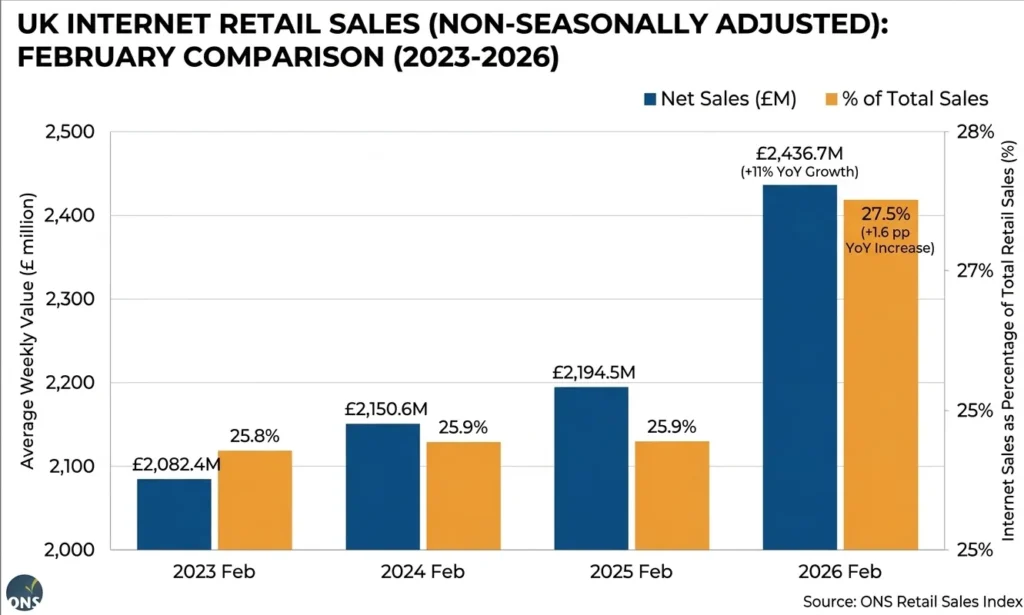
February data stands out. Online sales accounted for 27.5% of total retail, up sharply from the ~25.9% plateau seen between 2023 and 2025. Weekly online sales also jumped to £2.44 billion, marking an 11% year-on-year increase—a clear acceleration compared to the modest 2–3% growth of prior years.
More notably, e-commerce contributed over 60% of total retail growth in February alone, underscoring its renewed role as the primary driver of expansion in the UK retail economy.
This is not just seasonal noise. Historically, February has been one of the weakest months for online penetration. Yet in 2026, even this “low point” sits above much of the past three years—suggesting a higher baseline for digital commerce.
Seasonality Remains—But the Floor Has Lifted
The UK market still follows familiar patterns. November peaks, driven by Black Friday, continue to push online share above 30%, while January benefits from post-holiday demand and reduced offline activity.
However, the key shift in 2026 is resilience. Even after the typical post-January dip, online retail has held significantly stronger levels. Analysts now expect Black Friday 2026 to potentially exceed 34–35% online share, a new record.
What It Means for Dropshipping
For dropshipping operators, this rebound aligns with broader structural trends already visible in the UK market:
- Scale & Growth: UK online retail reached £132.15 billion in 2025, with steady recovery since the post-pandemic correction.
- Dropshipping Penetration: The model now accounts for roughly 14%+ of total e-commerce, rising to 16–20% in core categories like apparel and home goods.
- Future Expansion: With a projected 21.9% CAGR, dropshipping revenue is expected to hit £57.6 billion by 2030, approaching one-third of total online retail.
In practical terms, the latest ONS data reinforces what industry statistics have been संकेतing: the UK is no longer just a mature e-commerce market—it is re-accelerating, with infrastructure and consumer behavior already optimized for online-first retail.
Rising Standards, Not Just Rising Demand
That said, growth is no longer driven by easy arbitrage. UK consumers now expect:
- Fast delivery (often within 4 days)
- Free or flexible shipping options
- Low-friction returns
At the same time, the dropshipping landscape itself is evolving. Over 70% of new sellers are moving toward independent stores, with platforms like Shopify dominating the ecosystem.
This signals a shift from opportunistic selling to more disciplined, brand-oriented operations.
The Bigger Picture
Taken together, the March ONS release and 2026 market data point to a clear conclusion:
the UK’s e-commerce sector has moved past stabilization and is entering a new phase of sustained, structurally supported growth.
For dropshippers, the implication is straightforward—opportunity is expanding again, but so is the bar for execution.
Those able to combine strong product selection, efficient logistics, and localized customer experience are likely to benefit most from this next wave.