Launch your dropshipping journey today – Your first sale is closer than you think!


When I launched my first Shopify store, I had zero warehouse space, zero employees, and almost zero clue what I was doing. But one simple business model changed everything — dropshipping.
If you’ve ever wondered how some online stores manage to sell hundreds of products without ever touching a single box, this is their secret weapon.
Let’s break it down — simply, practically, and honestly.
🧩 What Is Dropshipping?
Dropshipping is a retail fulfillment model where you sell products online without keeping inventory yourself.
When a customer places an order, you forward the details to a third-party supplier (like a manufacturer or wholesaler). The supplier then ships the product directly to the customer under your store’s name.
You earn the price difference — the margin between what your customer pays and what you pay your supplier.
👉 In short:
You handle the marketing. The supplier handles the shipping.
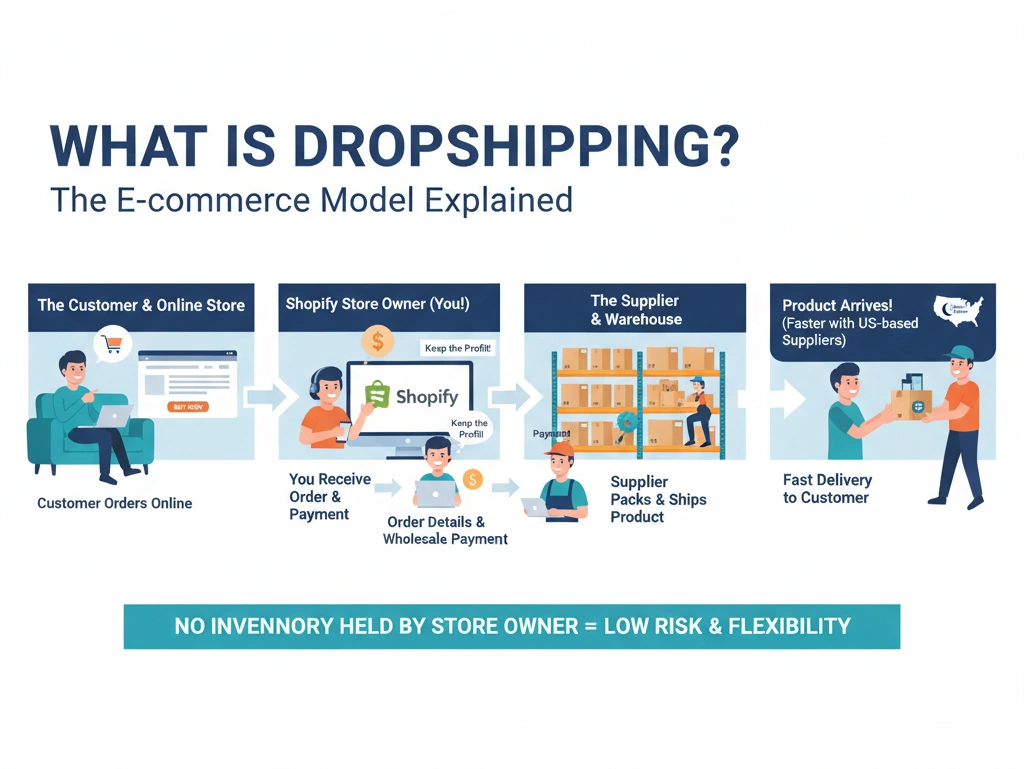
Here’s how it works:
- A customer orders from your Shopify store.
- You collect payment at retail price.
- You forward the order to your supplier and pay them the wholesale price.
- The supplier ships the product straight to your customer.
- You keep the profit.
That’s it — no warehouse, no stockroom, no packing tape.
💡 Why Dropshipping Appeals to Shopify Entrepreneurs
Dropshipping isn’t just another eCommerce trend — it’s a gateway into entrepreneurship. Especially for Shopify users in the U.S., the model offers freedom, flexibility, and surprisingly low risk.
Here’s why it works so well:
1. Low Startup Cost, Low Risk
No need to pre-buy inventory. Your biggest costs are marketing and your Shopify subscription — not a garage full of unsold stock.
2. Location Independence
You can run your store from anywhere — your apartment, a café in Austin, or a beach in Thailand. All you need is Wi-Fi and a laptop.
3. Product Flexibility
You can test hundreds of products without financial risk. If something doesn’t sell, just remove it — no losses, no leftover boxes.
4. Scalable Operations
As orders grow, you don’t need more storage or staff. You just process more orders — suppliers handle fulfillment.
5. Focus on Marketing & Branding
You get to do what matters most — building your brand, connecting with customers, and creating content that sells.
⚠️ The Trade-Offs: Dropshipping Isn’t Perfect
Let’s be honest — dropshipping isn’t a “get-rich-quick” scheme. It’s a real business, with real challenges.
Here’s what you’ll face (and how to handle it):
| Challenge | Reality | Strategy |
|---|---|---|
| Low Margins | Competition drives prices down. | Focus on branded, niche products and add value through storytelling. |
| Little Supply Chain Control | You don’t manage the warehouse or quality checks. | Work with reliable suppliers (like Ship To The Moon) who prioritize consistency. |
| High Competition | Many stores sell similar items. | Build a unique brand voice, not just a product catalog. |
| Customer Service Pressure | You’re the face of the brand, even if shipping delays happen. | Communicate clearly and use automated tracking systems. |
| Shipping Complexities | Multi-supplier orders can cause split deliveries. | Simplify by sourcing from consolidated, all-in-one suppliers. |
If you understand these trade-offs — and plan accordingly — dropshipping becomes a manageable, scalable, and highly profitable model.
🧭 How to Start a Dropshipping Business on Shopify
Ready to get started? Follow these five core steps to set up your first profitable store.
A. Choose a Profitable Niche
Don’t chase generic “hot sellers.” Look for specific problems to solve.
Examples:
- Pet grooming tools
- Ergonomic office gear
- Sustainable kitchen products
Pro Tip: Study customer pain points, not just product trends.
B. Build and Optimize Your Shopify Store
- Use a clean, fast-loading theme.
- Add trust badges and clear product categories.
- Offer multiple payment gateways.
Remember: simplicity converts better than flashy design.
C. Find Reliable Suppliers
Your supplier is the heartbeat of your dropshipping business.
Options include:
- U.S.-based suppliers (DropCommerce, Shopify Collective) for 3–7 day shipping.
- International suppliers (AliExpress, Alibaba) for product variety and low prices.
- Print-on-Demand partners (like Gelato) for custom, brandable items.
Or, work with Ship To The Moon — a trusted dropshipping supplier that combines fast shipping, global sourcing, and private labeling support.
D. Automate Everything You Can
Use Shopify apps like DSers, Syncee, or DropCommerce to automate:
- Product imports
- Price updates
- Inventory tracking
- Order forwarding
Automation = fewer headaches and more time for marketing.
E. Focus on Marketing & Branding
This is where the magic happens.
- Use TikTok Reels or Instagram videos to demonstrate product value.
- Build a story, not just a product page.
- Encourage photo reviews to build trust.
In the U.S. market, people buy from brands they feel connected to, not faceless stores.
🏗️ Supplier Strategy: Who You Work With Matters
When selecting suppliers, consider:
- Shipping time: U.S. buyers expect 5–7 days max.
- Product quality: Samples are worth every penny.
- Return policy: Smooth returns build long-term trust.
Pro Tip: For Shopify sellers in the U.S., partnering with a hybrid supplier like Ship To The Moon bridges the gap — you get Chinese-level wholesale prices with U.S.-standard logistics and branding support.
💰 Marketing + Customer Experience = Longevity
In a world where anyone can open a Shopify store, your advantage isn’t the product — it’s your brand experience.
- Offer free returns and fast shipping (via local suppliers).
- Use automated email follow-ups (with tools like Omnisend).
- Encourage photo reviews and influencer shoutouts.
These small touches create loyal customers — and repeat sales.
✨ Is Dropshipping Still Worth It in 2025?
Absolutely — but only if you treat it like a real business.
Dropshipping won’t make you rich overnight. But if you’re strategic — focusing on branding, storytelling, and strong supplier relationships — it can become a profitable and sustainable venture.
In the U.S. especially, where consumers crave fast delivery and unique products, Shopify + reliable suppliers = a winning formula.
🚀 Final Thought
Dropshipping isn’t about selling cheap products.
It’s about connecting great marketing with great logistics.
And with the right partner — like Ship To The Moon — you can build a brand that doesn’t just sell, but lasts.
So here’s your challenge:
👉 Don’t just start a Shopify store.
Start a real eCommerce brand powered by smart dropshipping.