


If you’ve spent any time in dropshipping, chances are you’ve come across CJ Dropshipping. It’s one of the most recognizable names in the space, often recommended to beginners for its “all-in-one” promise.
But here’s the thing most comparison posts don’t say out loud:
What works when you’re starting doesn’t always work when you’re trying to scale.
As margins tighten, ad costs rise, and competition increases, more sellers start looking for a CJ Dropshipping alternative that gives them better control over pricing, product differentiation, and fulfillment.
That’s where Ship To The Moon comes in.
This isn’t a “better vs worse” comparison. It’s about understanding two very different models—and choosing the one that actually fits your stage of business.
Why Sellers Start Questioning CJ Dropshipping
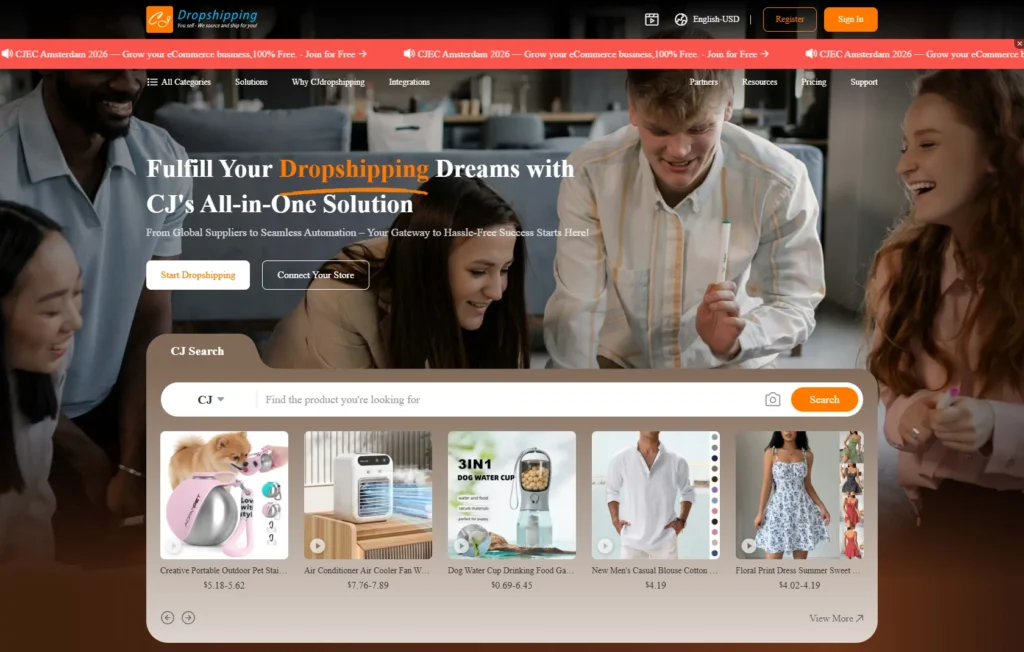
On paper, CJ is hard to beat. It combines product sourcing, fulfillment, and integrations into a single platform. According to publicly available traffic data (e.g., SimilarWeb), CJ attracts ~1.1–1.2 million monthly visits, with a large portion coming from direct traffic. That tells you one thing clearly: it has a massive, loyal user base.
User engagement is also strong. Average session durations exceed 8 minutes with multiple pages per visit. That’s not typical for a simple product catalog. It reflects how deeply users rely on the platform for daily operations.
But those same strengths reveal its limitations.
CJ is designed to work at scale. And when a system is built for scale, it tends to prioritize standardization over flexibility.
That’s where friction starts to show up:
- Pricing layers that aren’t always transparent
- Limited flexibility when you want to customize or improve a product
- Fulfillment that works well—but not always optimized for margin or speed
- Support that can feel inconsistent due to platform scale
None of these are deal-breakers when you’re testing products.
They become real constraints when you’re trying to build a brand or scale profitably.
Ship To The Moon vs CJ Dropshipping (Full Comparison)
Here’s a side-by-side breakdown that goes beyond surface-level features:
| Metrics | Ship To The Moon | CJ Dropshipping |
|---|---|---|
| Platform Positioning | Private sourcing & fulfillment partner focused on profit and scalability | All-in-one dropshipping platform combining SaaS + supply chain |
| User Entry Flow | Guided: consult → test products → scale winning SKUs | Self-service: sign up → browse products → order |
| Product Sourcing | Private sourcing + agent model + custom product development | Marketplace-style sourcing from factory network |
| Product Flexibility | High (customization, modification, product development) | High (mostly standard SKUs + private labeling) |
| Product Pricing Level | Factory-direct pricing with better margin control | Variable pricing with service & handling fees |
| Cost Transparency | High (clear, quote-based pricing) | Moderate (multiple hidden or bundled fees) |
| Profit Potential | High (optimized for higher margins) | Moderate (profits are easily squeezed) |
| Custom Branding | Flexible branding: packaging, inserts, logo, low barrier | Available but often requires MOQ |
| Print on Demand | Supported with flexible sourcing options | Strong in-house POD infrastructure |
| Product Photography | Customizable, flexible | Available as add-on service |
| Supply Chain Model | Private supply chain + dedicated agents | Platform-managed supplier network |
| Fulfillment Model | Hybrid: China shipping + local warehouse optimization | Standardized global fulfillment system |
| Warehouse Network | Global warehouses (US, EU, CN) with flexible allocation | Large global warehouse network |
| Shipping Speed (US) | 2–5 days from US warehouse | Typically 2–7 days |
| Shipping Speed (Global) | 6–12 days optimized shipping | 7–15 days from China |
| Logistics Flexibility | Custom shipping strategies for cost/speed balance | Standardized shipping options |
| Integrations | Shopify / WooCommerce / Etsy + API customization | Extensive (Shopify, TikTok Shop, Temu, eBay, Shopee, etc.) |
| Automation | Medium (automation + human optimization) | High (system-driven workflows) |
| Customer Support | Dedicated 1-on-1 account manager | 24/7 chat, ticket system |
| Communication Quality | High (direct, fast, English-friendly) | Mixed (scale leads to inconsistency) |
| Education & Resources | Blogs, guides, hands-on support | Blogs, tutorials, CJ Academy |
| Financial Services | No credit system, but better cash flow via margin optimization | Credit service available |
| Pricing Model | No subscription fees / per-order pricing / custom quotes | Free plan available, costs scale via services and usage |
| Ideal Use Case | Building a profitable, branded, long-term business | Quickly launching and managing many products |
The Real Difference: Platform vs Partner
Most comparisons stop at features. That misses the bigger picture.
CJ Dropshipping is a platform.
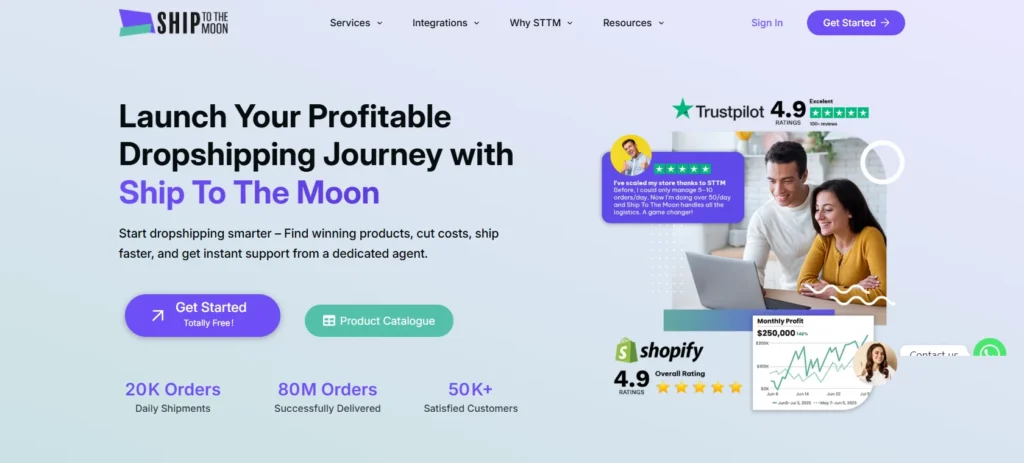
Ship To The Moon is a partner.
That difference shows up in how you operate your business day to day.
With CJ, you browse, test, and manage everything yourself inside a system. It’s efficient, especially when you’re running many products at once.
With Ship To The Moon, the workflow starts with a conversation. You bring an idea or a product, and the team helps refine sourcing, pricing, and logistics before you scale.
It’s a slower start. But it often leads to better unit economics.
Profit Margins: Where Most Sellers Feel the Shift
This is where many sellers start looking for a CJ alternative.
CJ’s pricing model works, but it often includes layers:
- Product cost
- Shipping cost
- Handling or service fees
- Variations depending on supplier
Individually, these don’t look significant. Together, they can quietly eat into margins.
Ship To The Moon approaches this differently. Pricing is typically quote-based and sourcing-driven, closer to factory level. That makes it easier to:
- Predict margins
- Adjust pricing strategies
- Scale winning products without margin collapse
In a market where ad costs keep rising, this difference matters more than ever.
Product Strategy: Testing vs Building
If your strategy is to test 20 products a week, CJ fits naturally.
Its marketplace-style sourcing makes it easy to launch quickly without much setup.
But once you find a winner, the game changes.
You may want to:
- Improve packaging
- Bundle products
- Adjust materials or features
- Build a recognizable brand
This is where Ship To The Moon tends to stand out. Its agent-based sourcing model allows for product iteration, not just distribution.
And that’s often what separates short-term wins from long-term brands.
Fulfillment and Shipping: Speed vs Optimization
CJ has a strong global warehouse network, and for many sellers, it delivers acceptable shipping times.
But fulfillment is largely standardized.
Ship To The Moon takes a more flexible approach:
- US warehouse for fast delivery (2–5 days)
- China fulfillment optimized for cost (6–12 days globally)
- Ability to adjust logistics based on product and market
Instead of one system, you get a strategy per product.
That flexibility can improve both customer experience and profitability at the same time.
Support and Communication: Scale Has a Cost
CJ offers 24/7 support, which sounds ideal. In practice, response quality can vary. That’s the trade-off of serving a massive global user base.
Ship To The Moon leans in the opposite direction.
You typically work with a dedicated account manager, which means:
- Faster responses
- Clear communication
- More context on your business
It’s a smaller-scale model, but often a more consistent one.
So, Which CJ Dropshipping Alternative Is Right for You?
It depends less on features and more on where you are in your journey.
If you’re:
- Just starting out
- Testing multiple products rapidly
- Looking for a plug-and-play system
CJ Dropshipping is still a solid choice.
If you’re:
- Scaling winning products
- Trying to improve margins
- Building a long-term brand
Then Ship To The Moon becomes a much stronger alternative.
Final Thoughts
There’s a reason CJ Dropshipping is so widely used. It lowers the barrier to entry and makes dropshipping accessible at scale.
But accessibility isn’t the same as optimization.
As the market matures, the sellers who win are the ones who control their margins, differentiate their products, and build systems that can evolve.
That’s exactly where Ship To The Moon is designed to fit.
Want to Scale Beyond “Testing Mode”?
If you already have products that show traction, it might be time to move beyond marketplace sourcing.
Ship To The Moon lets you:
- Source products closer to factory cost
- Customize and improve winning SKUs
- Optimize fulfillment for both speed and profit
You don’t need to switch everything overnight. Many sellers start by moving just one product and scaling from there.
That alone can change the economics of your entire store.