

If you’re building an ecommerce brand in 2026, sooner or later you run into the same question:
Ship To The Moon or Printify?
For many sellers, that question starts while searching for a reliable Printify alternative—something that can support growth beyond the early print-on-demand stage.
At first glance, both platforms help merchants fulfill products without holding inventory upfront. Both connect with ecommerce platforms like Shopify. Both can support print-on-demand businesses.
But once you look a little closer, they’re built for very different kinds of sellers.
Printify was designed around accessibility. It made print-on-demand easier for designers, Etsy sellers, and first-time entrepreneurs who wanted to launch quickly without managing production themselves.
Ship To The Moon was built from a different starting point. Instead of focusing only on POD, it was designed around supply chain flexibility—bringing together print-on-demand, product sourcing, private label manufacturing, custom packaging, and fulfillment in one system.
That distinction becomes more important as a business grows.
Because once orders become consistent, the conversation usually changes.
It stops being:
“Where can I print this product?”
and starts becoming:
“How do I build a stronger brand, protect my margins, and deliver a better customer experience?”
That’s where the difference between the two becomes much easier to see.
In this guide, we’ll compare Ship To The Moon and Printify from three practical angles: operational workflow, business model and profitability, and the day-to-day experience of running your store.
Whether you’re running an Etsy POD shop, scaling a Shopify brand, or selling through TikTok Shop, this comparison should help you decide which platform actually fits the business you’re trying to build.
Quick Comparison: Ship To The Moon vs Printify
Before going deeper, here’s the high-level view.
| Comparison Category | Ship To The Moon | Printify |
|---|---|---|
| Supply Chain Model | Self-managed integrated supply chain with deeply partnered manufacturing network | Decentralized third-party print provider marketplace |
| Production Control | Higher; production standards, packaging, and workflows can be managed more consistently | Lower; fulfillment depends on individual print providers |
| Factory Network Structure | China-centered supply chain covering POD, non-POD, custom packaging, and general dropshipping products | 90+ independent print providers across 140+ production locations worldwide |
| SKU Coverage | POD combined with general dropshipping products (home goods, beauty, accessories, gifts, etc.) | Primarily focused on 1,300+ POD SKUs |
| Product Customization Capabilities | POD + private label + packaging customization | Strong POD customization, but limited branding and packaging customization |
| Branding & Packaging | Supports logo packaging, custom inserts, private labeling, and custom boxes | Only selected providers offer insert cards or neck labels |
| Pricing Structure | Product cost + shipping fee, with a wholesale-oriented supply chain pricing model | Base product price + shipping + Premium subscription model |
| Subscription Fees | No mandatory membership fee | Free / Premium ($39/month)/ Enterprise (Custom pricing) |
| Profit Margin Potential | Better suited for high-ticket and high-margin branded products | Better suited for volume selling and lower-margin Etsy-focused sales |
| Order Fulfillment Model | Centralized fulfillment management | Decentralized fulfillment through individual providers |
| Quality Control Consistency | Easier to maintain consistent QC standards across orders | Quality may vary depending on the print provider |
| Automatic Routing Capability | Primarily relies on supply chain coordination and operational management | Built-in automatic order routing system |
| Shopify Integration | Strong support | Native integration |
| Etsy Integration | Supported | Strong and mature Etsy integration |
| Non-POD Product Capability | Strong | Limited |
| Private Label Capability | Strong | Limited |
| Customer Support & After-sales Workflow | Merchants communicate directly with the supply chain | Multi-layer communication between merchant, platform, and print provider |
| Peak Season Stability (Q4) | More dependent on warehouse coordination and production capacity planning | Provider backlogs are more common during peak seasons |
| Best Fit for Seller Type | Brand-focused Shopify stores, general dropshipping businesses, and private label brands | Etsy POD sellers, Shopify POD beginners, and design-first merchants |
At a glance, Printify is often the easier entry point.
Ship To The Moon tends to become more compelling once brand building, product expansion, or long-term scaling becomes the priority.
And that distinction really starts with the supply chain itself.
1. Core Difference: Integrated Supply Chain vs Marketplace Fulfillment
This is the biggest difference between Ship To The Moon and Printify.
Everything else—pricing, product range, branding options, even customer experience—comes from this one structural difference.
Ship To The Moon: Built Around a Managed Supply Chain
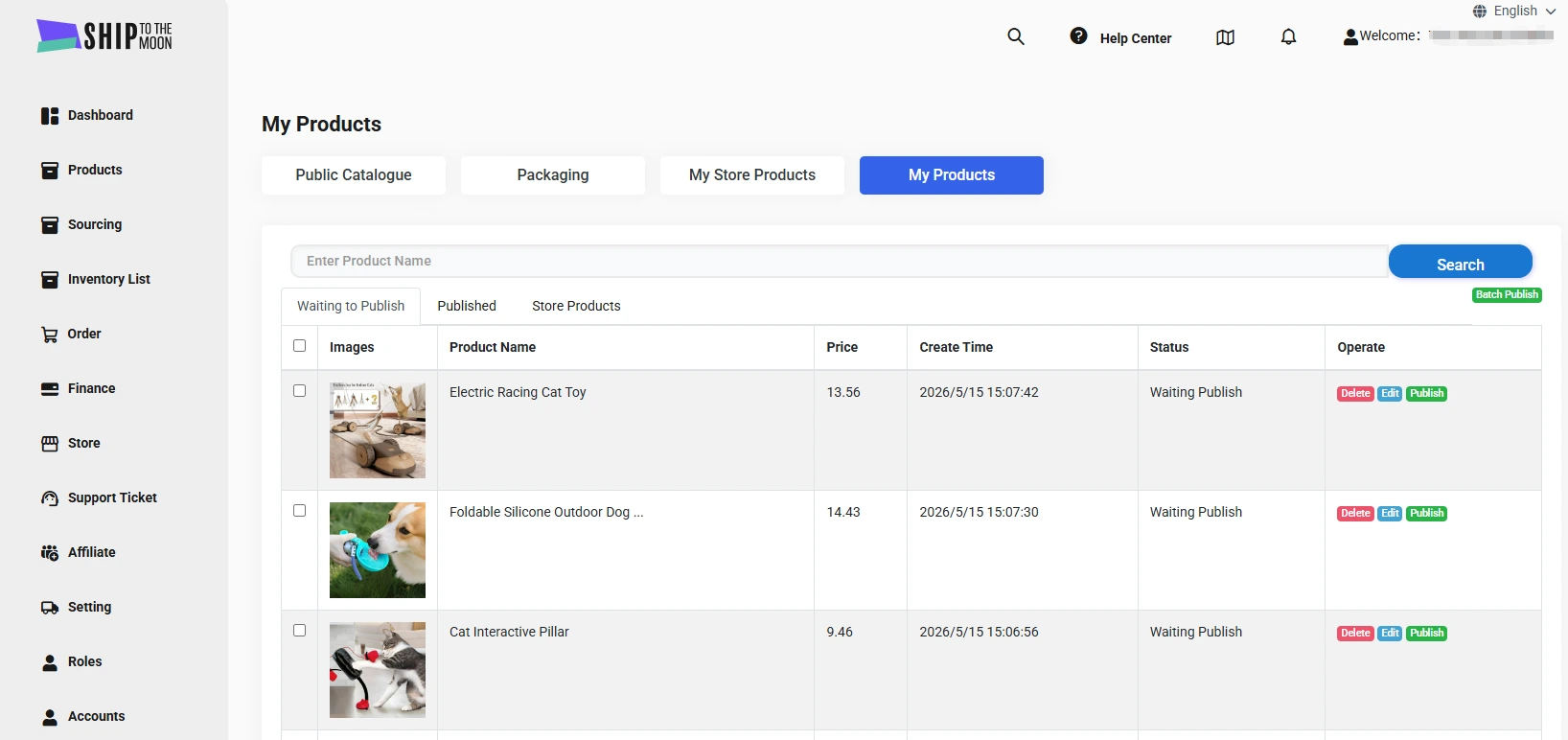
Ship To The Moon works more like a supply chain partner than a software marketplace.
Instead of sending orders across a wide network of disconnected print providers, it operates through a more coordinated manufacturing and fulfillment ecosystem.
That creates a different kind of merchant experience.
Products can be sourced across multiple categories, not just POD. Packaging can be standardized. Brand inserts can be added more consistently. Quality control becomes easier to manage because operations are less fragmented.
For sellers, this usually means more control.
And control matters.
Not just over product quality, but over how the brand shows up when the customer opens the package.
That includes things like:
custom mailers, logo packaging, inserts, private label labeling, bundled products, or mixing POD items with sourced non-POD products in the same store.
For brands trying to build a stronger identity, that flexibility is difficult to ignore.
Printify: Built Around a Provider Marketplace
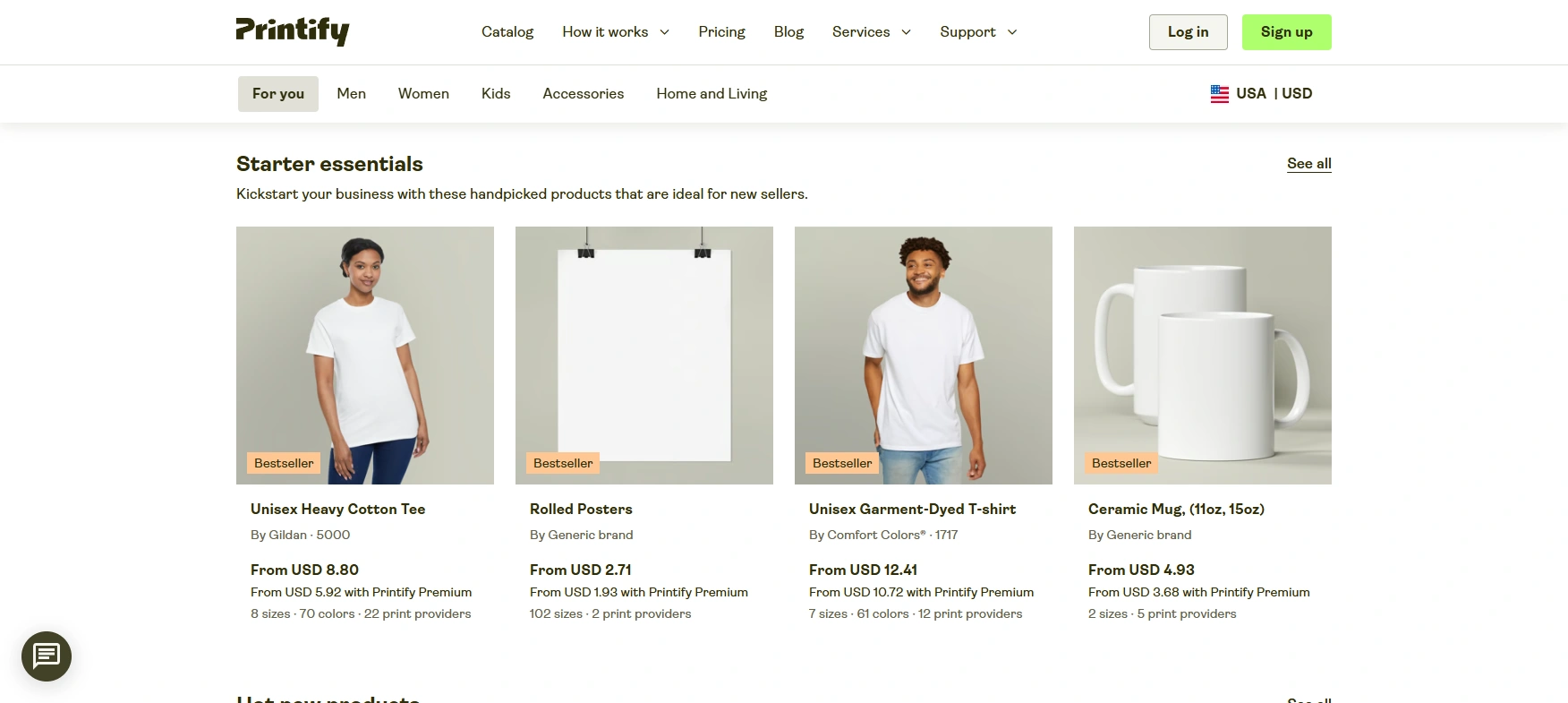
Printify works differently.
It connects merchants to a global network of independent print providers. You choose a product, select a provider, upload your design, and the provider fulfills the order.
This model is why Printify became so popular.
It’s fast.
A seller can launch a T-shirt or mug product in a single afternoon.
There’s very little friction between having an idea and listing it for sale.
For many creators, especially on Etsy, that speed is exactly the point.
But marketplace flexibility comes with tradeoffs.
Because each print provider operates independently, quality standards can vary.
Packaging can vary.
Production speed can vary.
Even the customer’s unboxing experience can feel inconsistent depending on which provider fulfilled the order.
For early-stage sellers, that may be acceptable.
For scaling brands, it becomes harder to manage.
Where Sellers Usually Feel the Difference
Most merchants don’t notice the gap between the two platforms on day one.
They feel it later.
Usually when one of these starts happening:
- orders increase quickly during Q4
- customers begin reordering
- average order value rises
- branding becomes more important
- product catalog expands beyond apparel
- customer service becomes harder to manage
That’s when operational structure stops being invisible.
And starts affecting the business directly.
Printify tends to optimize for launch speed.
Ship To The Moon tends to optimize for operational flexibility and brand scalability.
Neither is universally better.
But they are built for very different stages of ecommerce growth.
If Printify feels like a strong launch platform for POD sellers, Ship To The Moon feels more like infrastructure for building a broader ecommerce brand.
2. Product Range: Beyond Print-on-Demand vs POD-Focused
Product range doesn’t always feel like a major decision at the beginning.
For many sellers, launching with one or two products is enough. A hoodie, a mug, maybe a phone case—and that’s often all you need to get the store live and start testing demand.
But as a business grows, catalog strategy starts carrying more weight.
It affects average order value, cross-sell opportunities, repeat purchase behavior, and, over time, how customers understand your brand. What starts as a simple product decision often becomes part of a much bigger growth strategy.
This is another area where Ship To The Moon and Printify begin to diverge quite clearly.
Ship To The Moon: Built for Broader Product Expansion
Ship To The Moon extends well beyond traditional print-on-demand.
It supports core POD categories like apparel, accessories, gift items, and home products, but the supply chain isn’t limited to printable inventory. Sellers can also source non-POD items, custom products, branded packaging components, private label inventory, and general dropshipping products within the same operational ecosystem.
That creates more flexibility, both creatively and commercially.
A Shopify brand selling graphic tees can add candles or home décor without needing a separate sourcing partner. A TikTok Shop seller testing a trending mug design can introduce complementary accessories through the same fulfillment flow. A lifestyle brand can combine POD products with private label packaging and branded inserts while keeping the customer experience consistent.
This kind of flexibility makes product expansion easier to manage.
And for many ecommerce brands, that’s where the next stage of growth comes from—not simply selling more units of the same SKU, but widening the range of products customers can buy from the brand over time.
Printify: Strong in POD, Focused on POD
Printify remains one of the strongest print-on-demand platforms in the market.
Its catalog is deep where POD sellers need it most: T-shirts, hoodies, sweatshirts, tote bags, mugs, posters, journals, wall art, and other core merchandise categories. In many cases, sellers can choose between multiple print providers for the same item, which adds useful flexibility on the sourcing side.
For design-led businesses, that’s a real advantage.
The workflow is simple, fast, and proven. You create a design, publish the product, and start selling. For Etsy merchants especially, that model works extremely well because it removes operational complexity and makes launching new designs easy.
Where Printify becomes more limiting is when the business starts moving beyond traditional POD.
Once sellers begin building bundles, adding non-print items, or creating a broader branded product experience, the workflow often becomes more fragmented. That usually means managing multiple suppliers across multiple systems, which can add complexity both operationally and logistically.
3. Branding & Packaging: Selling Products vs Building a Brand
This is often where the decision becomes clearer for growing merchants.
Price matters. Integrations matter. Product selection matters too.
But branding tends to be the point where many sellers begin rethinking their fulfillment setup.
Because there’s a meaningful difference between shipping a product and delivering a brand experience.
Customers notice it the moment the order arrives—through the packaging, the insert card, the mailer, the presentation, and the overall feeling of opening the package.
These details may not seem critical on the first order. But they become increasingly important once repeat purchases, referrals, and customer loyalty enter the picture.
Ship To The Moon: More Control Over Brand Experience
Ship To The Moon gives merchants more control over how their brand shows up after checkout.
Custom packaging, logo mailers, insert cards, private label elements, and custom boxes can be integrated directly into the fulfillment workflow rather than added separately later. That makes branding part of operations instead of something layered on top of it.
For DTC brands, that can have a real impact.
Packaging becomes part of the overall customer experience. It influences perceived product value, strengthens brand recall, and can meaningfully improve the post-purchase experience customers associate with the business.
This becomes especially valuable for brands investing in paid acquisition, influencer campaigns, or creator-driven traffic, where customer retention matters just as much as the first conversion.
Printify: Functional Branding, but More Limited Flexibility
Printify does offer branding options through certain providers, but the experience tends to be less standardized.
Some providers offer neck labels. Some support inserts. Others offer little or no packaging customization at all. What’s available depends heavily on which fulfillment partner is producing the order.
For many POD sellers, especially those early in the journey, that level of branding is completely workable.
But for merchants building a more intentional brand experience, it can feel restrictive over time.
Printify is highly effective at helping sellers get products produced and shipped. Ship To The Moon gives sellers more influence over how those products are presented when they arrive.
4. Pricing & Profit Margins: Which One Leaves More Room to Grow?
Pricing is often where the comparison begins.
Margins are usually where the real decision gets made.
Because product cost alone rarely tells the full story. Shipping costs, packaging, customer acquisition, return rates, and brand positioning all shape profitability in different ways.
The more useful question is often this:
Which platform gives the business more room to grow profitably over time?
Printify
Printify’s pricing model is straightforward.
Merchants pay the product base cost, shipping, and optionally subscribe to Premium for lower pricing tiers. That structure is easy to understand and easy to model, which is part of why it works so well for newer POD sellers.
For Etsy businesses and design-first merchants, the economics are familiar and relatively predictable.
The challenge is that POD categories also tend to become highly competitive. T-shirts, mugs, posters, and similar products are easy to enter, which means pricing pressure builds quickly. As competition increases, margin often gets squeezed unless the brand has strong differentiation.
Ship To The Moon
Ship To The Moon operates through a more supply-chain-driven pricing model.
Product sourcing, production, packaging, and shipping function more like operational cost layers than fixed marketplace pricing. That structure often gives merchants more flexibility in how they position products and structure offers.
For branded ecommerce stores, this can create stronger margin opportunities.
Premium packaging can support higher retail pricing. Product bundles can increase average order value. Private label products can create differentiation that’s harder to compete against directly.
As a result, profitability isn’t only driven by lower sourcing cost. It’s often created through stronger brand positioning and a more premium customer experience.
For many scaling ecommerce brands, that becomes a more powerful margin lever over time.
5. Day-to-Day Operations: Which Platform Is Easier to Run?
This is where the comparison becomes very practical.
Beyond pricing and product selection, sellers eventually care about the daily operating experience—how easy orders are to manage, how support issues are handled, how fulfillment communication works, and how smoothly the system performs when volume increases.
Printify: Easier to Launch
Printify is exceptionally easy to get started with.
That remains one of its strongest advantages.
Its integrations are mature, the product setup flow is intuitive, and sellers can move from idea to live listing very quickly. For someone with little sourcing or operations experience, that simplicity lowers the barrier to entry considerably.
That’s a major reason Printify continues to work so well for first-time POD sellers.
Ship To The Moon: Better for Operational Depth
Ship To The Moon tends to become more valuable as operations become more layered.
This is especially true for merchants managing larger catalogs, custom packaging requirements, bundled offers, mixed POD and non-POD inventory, private label products, or fast-moving TikTok Shop sales.
At that stage, operational coordination becomes increasingly important.
Working through a more connected supply chain can reduce supplier switching, simplify communication, and create a smoother fulfillment process across different product categories.
Instead of stitching together multiple vendors to complete one customer order, sellers can run more of the business through a unified workflow.
For growing brands, that often creates operational clarity that becomes more valuable with scale.
6. Final Verdict: Which Platform Should You Choose?
There isn’t one universal winner between Ship To The Moon and Printify.
The better choice depends on the type of ecommerce business you’re building and what stage that business is in.
If you’re launching your first print-on-demand store, selling primarily design-led products, or building around Etsy, Printify remains an excellent option. It’s fast to set up, easy to manage, and built specifically for POD selling.
If you’re building a broader ecommerce brand—especially one focused on custom packaging, product expansion, private label, or stronger brand control—Ship To The Moon offers more flexibility and a wider operational foundation.
In many ways, the difference comes down to what you’re optimizing for.
Printify is optimized for speed and accessibility.
Ship To The Moon is optimized for flexibility, brand building, and long-term ecommerce scale.
Final Thoughts
Printify helped make print-on-demand accessible to millions of merchants, and it remains one of the strongest platforms for launching quickly.
Ship To The Moon addresses a different stage of ecommerce growth.
It becomes relevant when sellers start asking more operational and strategic questions:
- How do we improve margins without competing only on price?
- How do we create a stronger branded experience?
- How do we expand beyond standard POD products?
- How do we improve post-purchase experience for repeat customers?
- How do we scale fulfillment without managing multiple disconnected suppliers?
These questions usually appear once a business moves beyond launch mode.
At that point, fulfillment is no longer just backend logistics. It becomes part of the product experience, part of the brand, and increasingly part of what drives long-term growth.
If you’re looking for a fast and reliable way to launch a POD business, Printify is still a strong choice.
If you’re building for product flexibility, brand control, and scalable ecommerce growth, Ship To The Moon offers a broader foundation to build on.