

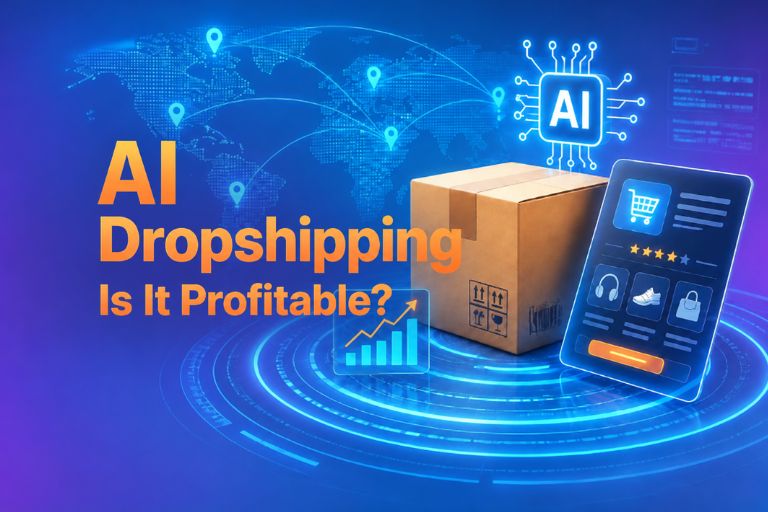
Artificial intelligence is changing how ecommerce businesses operate. From finding trending products and building online stores to writing product descriptions and creating advertising campaigns, AI tools are helping dropshippers complete tasks that once required hours of manual work.
But does that mean AI dropshipping is actually profitable? The short answer is yes, AI dropshipping can be profitable, but AI itself does not guarantee success.
Profitability still depends on product demand, supplier reliability, pricing, customer acquisition costs, shipping performance, and how effectively you manage your business. AI can reduce operational workload, accelerate product testing, and help you make more informed decisions. However, it cannot automatically turn an uncompetitive product into a bestseller or eliminate the costs of running an ecommerce business.
AI Dropshipping Business Model Explained
AI dropshipping combines the traditional dropshipping business model with artificial intelligence tools that support product research, store creation, marketing, customer service, and business analysis.
In traditional dropshipping, you sell products through an online store without holding inventory yourself. When a customer places an order, your supplier prepares and ships the product directly to the customer. You earn the difference between the selling price and your total business costs. AI does not fundamentally change this model. Instead, it helps you complete many of the tasks involved in running the business more efficiently.
How Does AI Dropshipping Work?
1. AI-powered product research
AI tools can analyze product trends, customer reviews, competitor listings, and search behavior to help identify potential opportunities. Instead of relying entirely on intuition, you can use these insights to create a shortlist of products worth testing.
However, trend signals are not proof of profitability. You still need to validate demand, competition, product quality, and expected margins before committing your budget.
2. AI-assisted store creation
AI website builders and ecommerce tools can help generate product descriptions, organize product categories, suggest store layouts, and draft marketing copy. These capabilities can make launching a store faster, especially for beginners.

You should still review the design, product information, shipping policies, return conditions, and checkout experience before publishing the store.
3. Supplier sourcing and fulfillment
Once you identify a product, you need a reliable supplier who can provide consistent quality, competitive pricing, and dependable shipping. AI can help compare supplier information, organize product specifications, and flag potential issues in supplier communications. However, it cannot independently guarantee that a supplier is trustworthy or that a product will meet customer expectations.
This is where a reliable sourcing and fulfillment partner becomes important. Ship To The Moon dropshipping can be part of this operational process by helping merchants access product sourcing and fulfillment solutions, depending on their product and service requirements.
4. AI-assisted marketing and optimization
AI can generate advertising concepts, product descriptions, email drafts, and social media content. It can also help analyze campaign performance and identify patterns in customer behavior.
You still need to test different offers, evaluate advertising costs, and make decisions based on actual sales data.
AI Dropshipping vs. Traditional Dropshipping
Business activity | Traditional approach | AI-assisted approach |
Product research | Manual browsing and research | AI-assisted trend and review analysis |
Store creation | Manual design and copywriting | AI-generated drafts and layouts |
Product descriptions | Written individually | Generated and edited in batches |
Advertising | Manual brainstorming and testing | AI-assisted creative generation |
Customer service | Primarily manual responses | Automated answers for routine questions |
Performance analysis | Manual spreadsheet analysis | AI-assisted reporting and insights |
The main advantage is efficiency. AI can help you test ideas faster and reduce repetitive work, but it does not remove the need for sound business decisions.
Real Costs of AI Dropshipping
One of the biggest misconceptions about AI powered dropshipping is that automation makes it almost free to operate. In reality, AI may reduce certain labor costs, but you still need to pay for products, ecommerce infrastructure, marketing, shipping, and customer service. Your total startup budget depends on your business model, the tools you choose, your product category, and how aggressively you plan to acquire customers.
AI Tool Costs
Many AI tools for dropshipping offer free plans, while more advanced features require monthly subscriptions.
Potential expenses include:
- AI product research and trend analysis tools.
- AI website builders or store design applications.
- AI writing and product description tools.
- AI image and video generation software.
- Advertising analytics and optimization tools.
- AI customer service applications.
Some functions may already be included in your ecommerce platform or existing subscriptions, so avoid paying for multiple tools that perform essentially the same task.
Website and Ecommerce Costs
- An ecommerce platform subscription.
- A domain name.
- Premium themes or store applications.
- Payment processing fees.
- Additional integrations.
For example, Shopify offers different subscription plans, and the actual cost depends on the plan, billing arrangement, and any additional applications you install. Check current pricing directly before preparing your budget.
Product and Fulfillment Costs
Dropshipping generally avoids the need to purchase large quantities of inventory upfront, but it does not eliminate product costs.
You must still account for:
- The supplier’s product price.
- Shipping and fulfillment charges.
- Packaging or customization fees.
- Possible duties, taxes, and other applicable import costs.
- Replacement orders, refunds, and damaged products.
These costs can vary considerably between suppliers, destinations, and product categories. A product with an attractive selling price may still be unprofitable if its shipping costs are too high or its quality leads to frequent refunds.
Marketing Costs
Marketing can be one of the largest expenses for a new dropshipping business. Potential costs include paid advertising, influencer collaborations, content production, and promotional discounts. AI can help you produce more advertising variations and test different messages. However, generating more ads does not automatically make those ads effective. You need to evaluate whether the revenue generated by a campaign is sufficient to cover product costs, fulfillment, advertising, and other expenses.
How Much Money Do You Need to Start?
The following figures are illustrative planning ranges, not verified industry averages or guaranteed minimums.
Expense category | Illustrative starting budget |
Domain and basic store setup | $20–$100 |
Ecommerce platform and applications | $30–$150 per month |
AI tools | $0–$100 per month |
Product samples and quality checks | $50–$200 |
Initial advertising tests | $100–$500 |
Refund and operating reserve | $100–$300 |
Some expenses are recurring, while others are one-time or variable costs. These figures should not simply be added together as if every merchant will incur every expense at the same time. A lean organic-marketing approach may require less upfront cash than a paid-advertising strategy. On the other hand, a business selling customized products or products with specialized shipping requirements may need a larger budget.
For a more detailed breakdown, see our dropshipping startup costs.
Free vs. Paid AI Dropshipping Tools
Can you start AI dropshipping for free? In some cases, yes.
Free AI tools can help beginners research product ideas, draft product descriptions, brainstorm advertising concepts, and plan their stores. This can be a practical way to explore the business model before investing in a larger technology stack.
However, a free AI tool does not mean the entire business is free. You may still need an ecommerce platform, a domain, supplier payments, shipping, payment processing, and a marketing budget.
What Can You Do With Free AI Tools?
- Brainstorming product and niche ideas.
- Drafting product descriptions.
- Creating basic customer personas.
- Writing initial advertising copy.
- Developing a content calendar.
- Reviewing small amounts of customer feedback.
Free plans may be sufficient for early-stage tasks. These tasks can help you move from an idea to a basic product validation plan without purchasing multiple subscriptions.
The limitations often involve usage caps, fewer integrations, limited automation, or restricted access to advanced features. Features also differ across providers and can change over time.
When Are Paid AI Tools Worth It?
Paid tools may become worthwhile when you have a clear operational need and can measure the value they provide.
For example, a paid application might help you process large product catalogs, connect your store with other systems, generate creative assets in batches, or automate repetitive customer service workflows.
Before subscribing, ask three questions:
- Which task will this tool improve?
- How much time or money will it realistically save?
- Will the improvement justify the subscription cost?
Suppose a tool costs $30 per month and saves you several hours of repetitive work. It may be worthwhile if those hours can be redirected toward product validation, supplier negotiation, or improving your conversion rate. But if you have not validated a product or generated consistent sales, adding more subscriptions may simply increase your operating expenses.
Factor | Free tools | Paid tools |
Initial investment | Usually lower | Requires a subscription or license |
Basic content generation | Often available | Usually offers additional capabilities |
Usage limits | May be restrictive | Often provides higher limits |
Integrations | May be limited | May offer more integrations |
Advanced automation | Often limited | More options may be available |
Best use case | Learning and early validation | Scaling proven workflows |
Our recommendation: Start with the smallest set of tools that allows you to validate your business model. Upgrade only when you encounter a specific limitation that affects productivity, customer experience, or dropshipping profitability.
Can AI Fully Automate Dropshipping?
AI can automate many parts of dropshipping, but a fully autonomous business that reliably selects winning products dropshipping, manages suppliers, resolves every customer issue, and generates consistent profits without human supervision remains an unrealistic expectation for most merchants.
The more practical goal is to automate repetitive tasks while keeping human oversight for decisions that involve money, quality, compliance, and customer trust.
What Can AI Automate?
Product research and analysis
AI can summarize reviews, identify recurring customer complaints, compare product attributes, and help prioritize potential products for testing. You should verify demand and competitive conditions using reliable data rather than treating AI-generated recommendations as definitive answers.
Content creation
AI can draft product descriptions, landing-page copy, emails, social media posts, and advertising concepts. Human editing remains important to ensure accuracy, originality, and consistency with your brand.
Customer service
AI chatbots can answer common questions about order status, shipping policies, and product details when they have access to accurate information.
Sensitive complaints, refund disputes, unusual delivery problems, and complex requests should have an escalation path to a human support representative.
Reporting and performance analysis
AI can help summarize sales data, identify unusual changes, and highlight possible areas for improvement. The usefulness of these insights depends on the quality of the underlying data.
What Still Requires Human Oversight?
Several important activities cannot safely be delegated entirely to AI:
- Verifying supplier reliability and product quality.
- Negotiating prices and resolving supplier disputes.
- Checking legal, safety, and advertising requirements.
- Approving marketing claims and product information.
- Managing exceptional shipping and refund cases.
- Deciding when to increase advertising budgets.
- Protecting customer information and account access.
For example, AI might identify a product with rapidly increasing search interest. However, it cannot guarantee that the product has sustainable demand, acceptable profit margins, reliable supply, or manageable return rates.
Similarly, AI can suggest a supplier based on available information, but that does not replace sample testing, service verification, or an assessment of shipping performance.
Fulfillment Still Matters
A well-designed AI workflow cannot compensate for unreliable fulfillment.
If orders arrive late, products differ from their descriptions, or tracking information is inaccurate, customers may request refunds or leave negative reviews. Those problems can damage your margins regardless of how sophisticated your marketing tools are.
This is why product sourcing, inventory visibility, order processing, and delivery performance should be considered part of your overall growth strategy. The goal is not to remove people from every process. It is to use AI where it improves efficiency and rely on dependable systems and human judgment where mistakes are expensive.
Explore our guide to dropshipping fulfillment center to understand how fulfillment operations support ecommerce businesses.
Common AI Dropshipping Mistakes
AI can make launching a store easier, but it can also help merchants make the wrong decisions faster. Avoiding the following mistakes is essential to building a sustainable business.
Mistake 1: Assuming AI-Generated Products Will Automatically Sell
AI can suggest products based on trends, reviews, and market signals, but it cannot guarantee demand or profitability. A product may attract attention while facing intense competition, low margins, expensive shipping, or weak repeat-purchase potential.
Validate each product using multiple signals, including customer demand, competitor pricing, supplier costs, delivery expectations, and expected contribution margin.
Mistake 2: Choosing Products Based Only on Viral Trends
Viral products can have short life cycles. By the time a trend becomes widely visible, many competitors may already be selling the same item.
Evaluate whether the product solves a meaningful customer problem, whether you can differentiate the offer, and whether demand is likely to persist beyond a temporary trend.
Mistake 3: Ignoring Supplier Quality
AI-generated product listings may look professional, but the actual product could be poorly made, inaccurately described, or difficult to ship.
Request samples where practical, verify specifications, review supplier performance, and establish clear expectations for quality and fulfillment.
Mistake 4: Publishing AI Content Without Reviewing It
AI may generate inaccurate product claims, repetitive descriptions, misleading shipping promises, or content that sounds generic. Publishing large quantities of unreviewed content can also weaken the usefulness and credibility of your store.
Review all important content for factual accuracy, originality, readability, search intent, and customer usefulness. Make sure product claims can be substantiated.
Mistake 5: Confusing Revenue With Profit
A store can generate substantial sales and still lose money if product costs, advertising, payment fees, refunds, and other expenses exceed its revenue.
Calculate contribution margin and track operating expenses before scaling campaigns. Use actual order and advertising data rather than optimistic estimates.
Mistake 6: Spending Too Much on AI Subscriptions
New merchants sometimes subscribe to several overlapping applications before they have enough orders to justify them.
Begin with essential tools, define a measurable purpose for each subscription, and cancel tools that do not provide sufficient value.
Mistake 7: Overlooking Customer Experience and Compliance
AI-generated marketing can create problems if it exaggerates product benefits, misrepresents delivery times, or makes unsupported claims. Depending on the product category and target market, additional consumer protection, labeling, safety, or advertising requirements may apply.
Review applicable requirements before selling, disclose shipping and return conditions clearly, and ensure that all product claims are accurate.
Ultimately, successful dropshipping with AI requires more than automation. It requires a product people want, a supplier you can rely on, a credible customer experience, and a business model that leaves room for profit.
Profit Calculation Example
To determine whether AI dropshipping is profitable, you need to calculate the money left over after variable costs and operating expenses.
Let’s consider an illustrative store selling a product for $40. Assume the following figures for one month:
Metric | Example |
Selling price per order | $40 |
Product cost per order | $12 |
Shipping and fulfillment per order | $5 |
Payment processing per order | $1.50 |
Advertising cost per acquired order | $10 |
Refund and returns allowance per order | $2 |
Other variable costs per order | $0.50 |
The total variable cost per order is:
$12 + $5 + $1.50 + $10 + $2 + $0.50 = $31
The contribution profit per order is:
$40 − $31 = $9
The contribution margin is:
$9 ÷ $40 × 100 = 22.5%
This means the store contributes $9 per order toward fixed operating expenses and profit.
What happens at different sales volumes? Assume the store receives 200 orders in a month.
Metric | Monthly result |
Revenue | $8,000 |
Total variable costs | $6,200 |
Contribution profit | $1,800 |
Fixed operating expenses | $300 |
Illustrative operating profit | $1,500 |
The $300 in fixed expenses might include software subscriptions, platform costs, and other recurring overhead not already included in the per-order calculation.
Under these assumptions, the store generates $1,500 in monthly operating profit before income taxes and any additional expenses not accounted for above.
These numbers are examples, not a forecast or an industry benchmark. Actual results can differ significantly depending on the product, supplier, advertising channel, customer acquisition costs, refunds, and order volume.
How AI Can Affect Profitability?
Reducing customer acquisition costs: Better audience research and creative testing may help improve advertising performance. However, lower costs are not guaranteed.
Increasing conversion rates: AI-assisted product descriptions, personalized content, and landing-page experiments may help more visitors complete purchases.
Reducing manual workload: Automating repetitive content and reporting tasks may lower the amount of time required to manage the store.
Improving product selection: AI-assisted analysis may help you identify promising products before committing too much money to inventory-independent but still costly product testing.
Consider what happens if advertising cost per acquired order falls from $10 to $8, while every other assumption stays the same. The contribution profit per order increases from $9 to $11. At 200 orders, that produces an additional $400 in monthly contribution profit. However, if the advertising change also reduces order volume or attracts lower-quality customers, the final result could be different. Always evaluate total profitability, not just one metric.
Calculate Your Break-Even ROAS
Return on ad spend (ROAS) measures advertising-attributed revenue divided by advertising spend.
In this example, the product sells for $40, and its non-advertising variable costs total $21 per order. That leaves $19 to cover advertising before the order generates a contribution profit.
The break-even ROAS, assuming the full $40 of revenue is attributable to advertising and excluding fixed costs, is:
$40 ÷ $19 ≈ 2.11
In other words, the store would need approximately $2.11 in attributed revenue for every $1 spent on advertising to cover the modeled non-advertising variable costs. A ROAS above this level does not automatically mean the entire business is profitable. You still need to account for fixed expenses, attribution limitations, taxes, and any costs omitted from the calculation.
For a more detailed explanation, see our guide to ROAS dropshipping.
FAQ
1. Can AI do dropshipping?
Yes, AI can automate many parts of a dropshipping business, including product research, product description writing, store content creation, marketing copy, customer support responses, and sales data analysis. However, AI cannot fully run a profitable dropshipping business without human oversight. Store owners still need to verify suppliers, check product quality, manage customer issues, monitor advertising costs, and make strategic decisions.
2. Is AI dropshipping worth it?
AI dropshipping can be worth it if you use AI tools to reduce repetitive work, test product ideas faster, and improve marketing efficiency. It may be especially useful for beginners who want to streamline product research and store setup. However, AI does not guarantee sales or profits. Your results depend on product demand, supplier reliability, pricing, advertising costs, shipping times, and customer experience.
3. How does AI dropshipping work?
AI dropshipping combines artificial intelligence tools with the traditional dropshipping business model.
First, AI tools help identify potential products by analyzing trends, customer interests, and competitor activity.
Next, AI can assist with creating product descriptions, building store content, generating advertising creatives, and personalizing marketing campaigns.
When a customer places an order, the seller purchases the product from a supplier, who ships it directly to the customer. The seller remains responsible for pricing, customer service, order issues, and overall profitability, even when some tasks are automated.
4. How much can I earn from AI dropshipping?
Earnings from AI dropshipping vary widely, and there is no guaranteed income. Some stores may struggle to generate sales, while others may become profitable after testing products, optimizing marketing, and improving operations. Your actual profit depends on your selling price, product and fulfillment costs, payment fees, advertising spend, refunds, and other business expenses.
AI dropshipping can be a worthwhile business model in 2027, particularly for merchants who use AI to reduce repetitive work, test products more efficiently, and make better-informed decisions. However, it is not a shortcut to guaranteed income. AI tools cannot eliminate product costs, guarantee supplier quality, create sustainable demand on their own, or remove the need for sound financial management.
The strongest approach is to combine AI-assisted research and marketing with reliable product sourcing, realistic profit calculations, clear customer communication, and dependable fulfillment.
- If you are a beginner, start small. Validate a few products, monitor your contribution margin, and invest in tools only when they solve a real problem.
- If you are already operating a store, focus on the bottlenecks that have the greatest effect on profitability, whether that means improving conversion rates, reducing customer acquisition costs, or making fulfillment more reliable.
Ship To The Moon can support merchants looking for sourcing and fulfillment solutions as they develop and scale their ecommerce operations. Explore our dropshipping services to learn more about the available options for your business.
The bottom line: AI can make dropshipping more efficient, but sustainable profitability still comes from choosing the right products, controlling costs, serving customers well, and building an operation that can grow without sacrificing quality.