


For dropshipping businesses targeting customers in the United States, choosing where to store and ship products can have a major impact on profitability, customer satisfaction, and business growth.
Two common fulfillment models are shipping orders directly from China and storing inventory in a US warehouse.
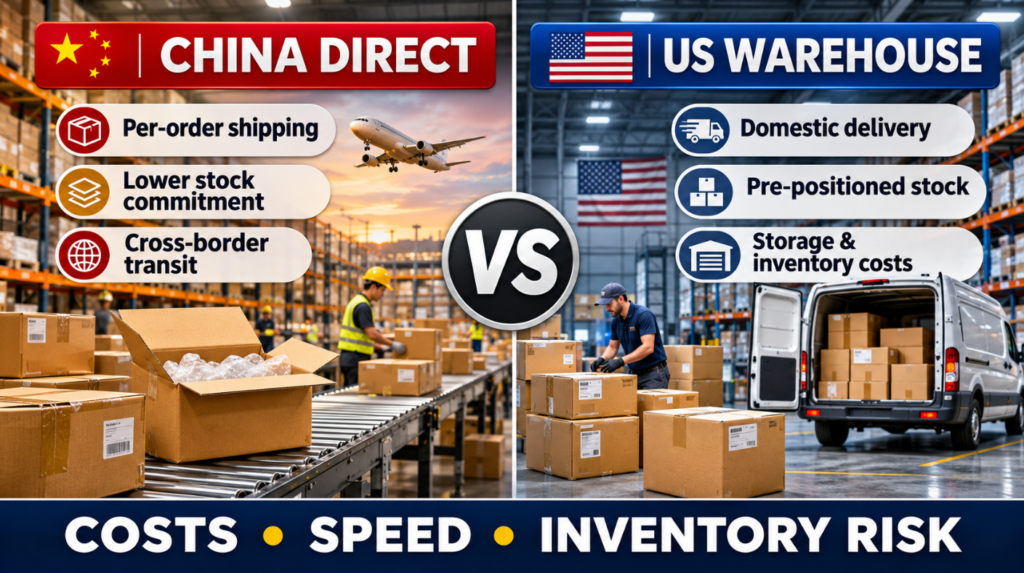
Shipping directly from China allows sellers to fulfill orders without sending large quantities of inventory overseas in advance. A US warehouse, on the other hand, places products closer to customers, making domestic delivery faster and potentially improving the post-purchase experience. However, faster delivery does not automatically mean lower costs. US warehousing involves additional expenses such as bulk freight, import duties, receiving, storage, and inventory investment. China direct shipping avoids some upfront inventory commitments but may involve longer delivery times and international shipping costs for every order.
So, which model is better for dropshipping? The answer depends on your product demand, order volume, profit margins, delivery expectations, and available working capital.
How Each Model Works?
Before comparing costs and delivery times, it is important to understand how these two fulfillment models operate.
US Warehouse Fulfillment
With US warehouse fulfillment, sellers purchase inventory from suppliers, usually in China, and ship products in bulk to a warehouse located in the United States. Once the inventory arrives and is checked in, the warehouse stores the products and fulfills individual customer orders.
The process generally looks like this:
- Source products from a manufacturer or supplier.
- Purchase inventory in advance.
- Ship bulk inventory from China to the United States.
- Complete customs clearance and warehouse receiving.
- Store inventory in a US fulfillment center.
- Pick, pack, and ship individual orders to customers.
Because the products are already in the United States, orders can be delivered through domestic carriers without waiting for international transportation after the customer places an order.
Main advantages:
- Faster domestic delivery.
- Better control over available inventory.
- Easier to offer shorter delivery estimates.
- More convenient domestic returns and exchanges when a suitable returns process is available.
Main disadvantages:
- Requires upfront inventory investment.
- Adds international inbound freight and import costs.
- Involves warehouse receiving and storage fees.
- Creates overstock and stockout risks.
China Direct Shipping
With China direct shipping, products are sourced and fulfilled in China. Instead of shipping bulk inventory to the United States before receiving customer orders, the seller arranges fulfillment on a per-order basis.
The process generally looks like this:
- Find a product and confirm supplier availability.
- Receive a customer order.
- Purchase or allocate the product from the supplier.
- Complete quality checks and order processing.
- Pack and dispatch the parcel from China.
- Ship internationally to the US customer.
This model is commonly used by dropshipping sellers who want to test products without committing to large inventory purchases.
Main advantages:
- Lower upfront inventory commitment.
- Easier to test new products.
- Inventory can remain closer to manufacturers.
- More flexibility when demand is uncertain.
Main disadvantages:
- Longer international delivery times.
- International shipping costs apply to individual orders.
- Customs duties and import procedures need to be considered.
- Delivery performance depends on the shipping route and logistics provider.
Which Model Is More Cost-Effective?
Cost is often the first factor sellers consider when choosing a fulfillment model. However, comparing only the shipping price per order can lead to the wrong decision. A more accurate comparison should include the full cost of getting a product from the supplier to the customer.
Per-Order Fulfillment Costs
| Cost Component | US Warehouse | China Direct Shipping |
| Product sourcing | Paid before bulk shipment | Paid when inventory is purchased or allocated for orders |
| International inbound freight | Required for bulk inventory | Included in the individual shipment arrangement |
| Customs duties and import fees | Paid on bulk import | Must be accounted for on individual shipments |
| Warehouse receiving | Usually applicable | Depends on the China fulfillment arrangement |
| Storage fees | Usually applicable | Depends on the China warehouse arrangement |
| Pick and pack | Charged per order | Charged per order |
| Last-mile shipping | Domestic US shipping | International shipping to the US customer |
| Inventory investment | Higher upfront commitment | Can be lower when fulfilled per order |
A US warehouse may offer lower domestic shipping rates, particularly at higher order volumes. However, sellers must also account for the cost of moving inventory into the United States and keeping it there. China direct shipping may have fewer upfront warehouse expenses, but international parcel rates and import-related costs can increase the total cost per order. The most cost-effective option depends on the product’s size, weight, value, order volume, and shipping arrangement.
Hidden Costs of US Warehouse Fulfillment
The advertised pick-and-pack price is only one part of a US warehouse’s cost structure.
Sellers should also consider:
1. Inbound Freight
Products must first travel from the supplier to the US warehouse. This may involve domestic transportation in China, export handling, international freight, customs clearance, and delivery to the warehouse.
2. Receiving Fees
Warehouses may charge for unloading, counting, inspecting, labeling, and putting inventory away.
3. Storage Fees
Inventory that remains in the warehouse may incur monthly storage charges. Slow-moving products can become increasingly expensive to hold.
4. Pick-and-Pack Fees
Every customer order requires warehouse labor and packaging materials. Additional items in a single order may incur extra handling fees.
5. Returns Processing
Returns may require inspection, restocking, repackaging, disposal, or additional transportation.
Import Duties and Customs
Import duties are an important part of the cost comparison, especially for products shipped from China to the United States.
The previous assumption that shipments valued at $800 or less automatically qualify for duty-free de minimis treatment is no longer valid for relevant imports. US Customs and Border Protection has published updated guidance on the suspension of this treatment and the applicable entry and duty requirements.
This affects both fulfillment models, but the timing and structure of the costs can differ:
- US warehouse model: Duties and import costs are generally incurred when bulk inventory enters the United States. These costs can be allocated across the units in the shipment.
- China direct model: Applicable duties, taxes, and customs processing costs need to be handled for individual customer shipments under the relevant entry arrangement.
If your logistics provider offers Delivered Duty Paid (DDP) shipping, confirm exactly which duties, taxes, and customs fees are included in the quoted price. Do not assume that DDP means every possible import-related cost is automatically covered. Confirm the importer-of-record arrangement, product classification, declared value, and responsibility for any additional charges.
Actual duty rates depend on the product’s tariff classification, country of origin, and applicable trade measures. Sellers should verify the current requirements rather than applying one general percentage to every product.
Cash Flow and Working Capital
One of the biggest differences between the two models is when your money is committed.
With a US warehouse, you usually pay for inventory and international freight before the products are sold. Your cash may remain tied up during production, transportation, customs clearance, warehouse receiving, and the selling period. With China direct shipping, you can often purchase or allocate products as orders arrive. This reduces the amount of inventory you need to pre-purchase, although supplier payment terms and fulfillment arrangements still matter.
Consider this simplified example:
A product costs $8 per unit, and your store expects to sell 20 units per day.
If you decide to hold 60 days of inventory in a US warehouse:
20 units × 60 days × $8 = $9,600 in product inventory investment.
This calculation excludes freight, duties, receiving, storage, and other expenses.
The same product fulfilled per order from China may require a much smaller upfront inventory commitment, depending on your supplier’s stock availability and payment terms. The trade-off is that you may have longer delivery times and different per-order shipping costs.
The important question is not simply which model has the lower shipping fee. It is how much working capital each model requires and what that capital could otherwise be used for, such as advertising, product testing, and business expansion.
Which Model Delivers Faster?
Shipping speed is one of the clearest differences between US warehouse fulfillment and China direct shipping.
However, sellers should compare the complete order-to-door timeline, not just the carrier’s advertised transit time.
US Warehouse Delivery Time
When inventory is already available in a US warehouse, an order can usually enter the domestic fulfillment process shortly after purchase.
A general planning estimate for domestic warehouse fulfillment is:
| Fulfillment Stage | Estimated Time |
| Order processing and picking | 1–2 business days |
| Packing and carrier handoff | 1 business day |
| Domestic transit | 2–5 business days |
| Estimated total | 3–8 business days |
Actual delivery times depend on the warehouse’s processing schedule, carrier service, destination, and order volume.
For example, USPS Ground Advantage publishes a standard delivery timeframe of 2–5 business days. This is a carrier standard, not a guarantee, and it begins after the parcel enters the carrier network.
China Direct Shipping Delivery Time
China direct shipping involves additional steps before the parcel reaches the US customer.
A typical process may include:
- Supplier confirmation and product preparation.
- Quality inspection and order processing.
- Export handling and international dispatch.
- International transportation.
- Customs processing.
- Last-mile delivery in the United States.
A general planning estimate for China-to-US direct shipping is around 7–15 business days, although actual delivery can be faster or slower depending on the route and service.
Ship To The Moon lists standard order processing as 1–3 business days, subject to stock availability. Its faster dispatch statement applies to pre-stocked products, so sellers should avoid applying the same preparation estimate to every SKU.
One 2026 logistics provider’s published dataset reported a median of 13 calendar days from order to delivery for its US orders shipped directly from China between June and August 2026. The middle half of those orders arrived between 10.6 and 16.5 days. This is a provider-specific result, not a universal industry average.
Order-to-Door Comparison
| Factor | US Warehouse | China Direct Shipping |
| Product location | Already in the United States | China |
| Order processing | Domestic warehouse processing | Supplier and China warehouse processing |
| International shipping after order | Usually not required | Required |
| Typical planning estimate | 3–8 business days | Around 7–15 business days |
| Customs after customer order | Usually not required for domestic delivery | May be required |
| Delivery consistency | Depends on local inventory and domestic carrier | Depends on international route and customs |
The US warehouse model generally provides a shorter post-order delivery window because the international transportation stage has already happened before the customer places an order. However, sellers must remember that the bulk inventory shipment to the US warehouse can take several weeks. That time is part of the overall supply chain, even though it does not appear in the customer’s delivery estimate.
Inventory Risk in Stocking in the US vs. Fulfilling from China
Inventory risk is often overlooked when sellers compare warehouse and shipping costs.
The decision to store inventory in the United States is also a decision to commit capital before knowing exactly how many units customers will buy.
Overstocking and Unsold Inventory
When sellers purchase inventory in bulk and send it to a US warehouse, they must forecast demand in advance. If the product performs worse than expected, unsold stock may continue generating storage fees and tying up working capital. This is particularly risky for newly launched products, seasonal products, trend-driven products, and products with uncertain demand, products with many similar competitors.
China direct shipping can reduce this risk because sellers do not necessarily need to pre-position large quantities of stock in the United States.
If a product stops selling, the seller can often reduce or stop purchasing it without being left with a large quantity of unsold US inventory.
Stockouts and Replenishment Delays
US warehousing also creates the opposite problem: running out of stock.
If sales increase unexpectedly, the available inventory may not last until the next bulk shipment arrives.
For example, a product that normally sells 20 units per day may suddenly sell 50 units per day after a successful advertising campaign. If the seller has not planned enough safety stock, the warehouse may run out before the next shipment arrives.
Replenishment planning should account for:
- Production lead time.
- Export and international freight.
- Customs clearance.
- Warehouse receiving time.
- Expected sales during the replenishment period.
- Safety stock.
China direct shipping can offer more flexibility when products are sourced close to manufacturers, but supplier stock availability and production capacity still need to be confirmed.
Product Testing and Demand Uncertainty
For new products, China direct shipping can be a practical way to validate demand before making a large inventory investment.
You can test customer interest, conversion rates, product reviews, return rates, advertising performance and repeat purchase behavior.
Once a product demonstrates stable demand, you can evaluate whether moving part of its inventory to a US warehouse makes financial sense. This reduces the risk of sending large quantities of an unproven product to the US market.
Side-by-Side Comparison
| Comparison Factor | US Warehouse | China Direct Shipping |
| Delivery speed | Faster domestic delivery | Longer international delivery |
| Upfront investment | Higher | Generally lower |
| Per-order shipping | Usually lower domestic shipping rates | International parcel rates |
| Inbound freight | Required for bulk inventory | No bulk inbound shipment to the US required |
| Storage costs | US warehouse storage fees | Depends on China warehouse arrangement |
| Customs costs | Generally paid on bulk import | Applicable import costs handled per shipment |
| Inventory risk | Higher risk of overstocking | Lower upfront inventory commitment |
| Stockout risk | Replenishment can take weeks | Depends on supplier availability and processing |
| Product testing | Less flexible if bulk inventory is required | More flexible for testing new products |
| Returns | Can be easier with local inventory and returns support | Requires a suitable local returns solution |
| Best suited for | Proven products with predictable demand | New products and uncertain demand |
Neither model is automatically cheaper or better. The right choice depends on the full cost per delivered order, how much capital you can commit, and what delivery experience your customers expect.
When Should You Choose a US Warehouse?
A US warehouse may be the better option when your business has established demand and needs to improve delivery performance.
Consider US warehouse fulfillment if:
Your Product Has Consistent Sales
If a product has maintained stable sales over several months, you may have enough data to forecast inventory requirements. Predictable demand makes it easier to calculate how much stock to send to the United States.
Delivery Speed Is Affecting Conversions
If customers frequently abandon purchases because of long delivery estimates, a domestic fulfillment option may help improve the shopping experience. It can also reduce customer inquiries about delayed orders.
Your Product Has Healthy Margins
A US warehouse adds costs beyond the product itself. You should have enough margin to cover inbound freight, duties, storage, receiving, and domestic fulfillment. Calculate the total landed cost before committing to inventory.
You Have Enough Working Capital
Do not send inventory to a US warehouse simply because domestic delivery is faster. Make sure you can afford the inventory commitment without compromising your advertising budget, operating expenses, or ability to test new products.
When Is China Direct Shipping the Better Choice?
China direct shipping is often more suitable for sellers who prioritize flexibility and want to avoid large upfront inventory commitments.
Consider this model if:
You Are Testing New Products
If demand is still uncertain, shipping orders directly from China allows you to test products without immediately purchasing large quantities for a US warehouse.
Your Product Has Low or Unpredictable Sales Volume
For products that sell irregularly, long-term storage fees and unsold inventory can outweigh the benefits of domestic delivery.
You Want to Keep More Cash Available
China direct shipping can reduce the amount of capital tied up in inventory stored overseas. This can be especially useful for smaller sellers who need cash available for marketing and product development.
Your Customers Accept Longer Delivery Times
Not every product requires two-day delivery.
Customers purchasing unique, customized, or hard-to-find products may be more willing to accept longer shipping times, provided that the delivery estimate is clear and realistic.
A Hybrid Fulfillment Strategy May Work Best
Choosing between a US warehouse and China direct shipping does not have to be an all-or-nothing decision.
For many dropshipping businesses, a hybrid fulfillment strategy offers a more flexible way to balance delivery speed, inventory costs, and demand uncertainty. Under this approach, sellers use different fulfillment routes for different products.
Test New Products Through China Direct Shipping
Start with China-based sourcing and fulfillment while collecting sales data. This allows you to evaluate demand before committing to bulk inventory.
Move Proven Bestsellers to a US Warehouse
Once a product has demonstrated consistent demand, calculate whether domestic fulfillment can improve delivery performance enough to justify the additional inventory investment.
Keep Slow-Moving Products in China
Products with irregular demand or lower sales volume may remain in China to avoid unnecessary US storage costs.
Use China as a Replenishment and Backup Option
Even when your bestsellers are stocked in the United States, China-based sourcing and fulfillment can provide an alternative when domestic inventory runs low. This approach can reduce dependence on a single warehouse location.
Example of a hybrid strategy:
| Product Type | Recommended Fulfillment Model | Reason |
| New product under testing | China direct shipping | Avoid large upfront inventory commitments |
| Consistent bestseller | US warehouse | Faster delivery for predictable demand |
| Seasonal product | Depends on sales forecast | Avoid leftover inventory after the season |
| Slow-moving product | China direct shipping | Reduce long-term storage costs |
| High-demand product during peak season | US warehouse + China backup | Improve delivery speed while maintaining replenishment flexibility |
The key is to make fulfillment decisions at the product level rather than forcing every SKU into the same model.
Ship To The Moon’s global warehouse network provides a basis for discussing both models with one fulfillment partner: standard orders default to its China hub, while pre-stocked items ship from their inventory location. For sellers considering this approach, the next step is to confirm which SKUs can be stocked in its California or New York locations, the cost of moving inventory there, and the applicable fulfillment terms.
5 Questions to Ask Before Choosing
Before moving inventory to a US warehouse or continuing with China direct shipping, answer these five questions.
1. How stable is your product demand?
If sales are still unpredictable, avoid committing too much inventory upfront.
2. How much does delivery speed matter to your customers?
Review customer feedback, conversion data, and delivery-related complaints to understand whether faster shipping could improve performance.
3. What is your real total fulfillment cost?
Include product cost, inbound freight, duties, customs fees, storage, receiving, pick and pack, shipping, and returns.
4. How much working capital can you afford to tie up?
Calculate the inventory investment required for the full replenishment cycle, not just the number of units currently in stock.
5. Can your fulfillment partner support both models?
A flexible sourcing and fulfillment partner can help you test products, manage inventory, and adjust shipping routes as your business grows.
For sellers who need support with product sourcing and order processing, Ship To The Moon’s dropshipping services can be a starting point for understanding how sourcing and fulfillment fit into the supply chain. You can also review the product sourcing guide when evaluating suppliers and products before scaling.
Choose the Fulfillment Model That Matches Your Business Stage
US warehouse fulfillment and China direct shipping serve different business needs.
A US warehouse can provide faster domestic delivery and a better post-purchase experience, but it requires more upfront investment and careful inventory management. China direct shipping offers greater flexibility for product testing and can reduce the need to commit large amounts of capital to overseas inventory. However, sellers must account for international delivery times, shipping costs, and import requirements.
For many dropshipping businesses, the most practical approach is to start with flexible China-based fulfillment, identify products with stable demand, and gradually move proven bestsellers to US warehouses when the numbers justify it.
The best fulfillment strategy is not simply the one with the lowest shipping rate or fastest delivery. It is the one that balances total costs, customer expectations, and inventory risk while supporting sustainable business growth.
FAQs
Is a US warehouse cheaper than shipping directly from China?
Not necessarily. A US warehouse can reduce domestic shipping costs per order, but sellers must also pay for bulk inbound freight, import duties, receiving, storage, and inventory investment. China direct shipping may have lower upfront inventory costs, but international parcel shipping and customs-related expenses can increase the cost of each order.
Compare the total landed and fulfilled cost per delivered order before choosing.
Is China direct shipping still profitable for US dropshipping in 2026?
It can be, depending on product margins, shipping costs, customs obligations, supplier pricing, and customer delivery expectations. Sellers should not assume that low-value shipments automatically qualify for duty-free treatment. Review current US import requirements and calculate applicable duties and fees for each product.
When should I move my dropshipping products to a US warehouse?
Consider moving products when they have demonstrated stable demand, delivery speed has become important to customers, and the expected savings or sales improvement justify the inventory and warehouse costs.
A product that is still being tested may be better suited to China direct shipping.
Can I use both a US warehouse and China direct shipping?
Yes. A hybrid fulfillment strategy allows you to store proven bestsellers in the United States while continuing to test new or slow-moving products through China-based fulfillment. This can help balance delivery speed, cash flow, and inventory risk.
What is the biggest risk of using a US warehouse?
The biggest risk is committing too much capital to inventory before demand is sufficiently predictable. If products do not sell as expected, sellers may face unsold stock, ongoing storage fees, and reduced working capital. Accurate demand forecasting and careful replenishment planning are essential.
Does China direct shipping mean I do not need to hold inventory?
Not necessarily. You may not need to pre-position inventory in the United States, but your supplier or China-based fulfillment partner still needs access to available stock. Product availability, supplier lead times, and replenishment arrangements should always be confirmed.