

Starting a dropshipping business often means handling many tasks yourself. You find products, communicate with suppliers, place orders, check tracking updates, and respond to customer questions. When order volume is low, this hands-on approach can be a practical way to learn how your business works without investing in inventory or warehouse space.
But as your store grows, the same process can become harder to manage. You may spend hours coordinating orders with suppliers, dealing with shipping delays, checking product availability, and resolving fulfillment issues. Instead of focusing on marketing, product development, and customer experience, more of your time goes into daily operations.
This is when working with a dropshipping fulfillment partner may become worth considering.
However, there is no universal order-volume threshold for making the switch. The right time depends on your workload, supplier complexity, fulfillment costs, customer expectations, and growth plans.
What Is DIY Dropshipping?
DIY dropshipping refers to a business model in which the seller manages most of the sourcing and order coordination independently, while suppliers ship products directly to customers.
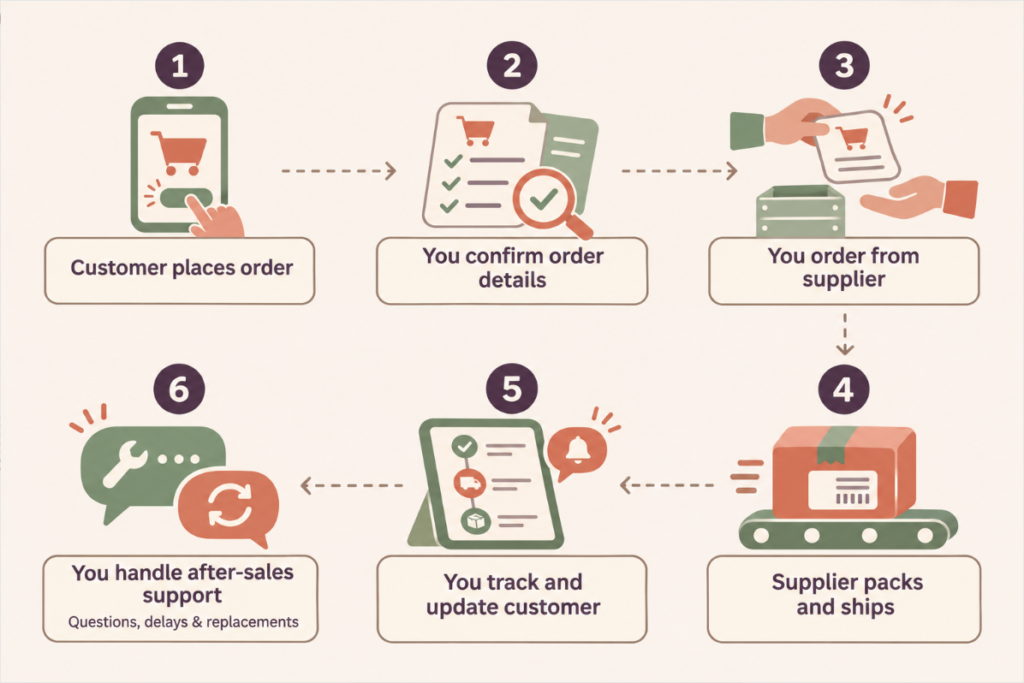
A typical workflow looks like this:
- A customer places an order in your online store.
- You receive the order and confirm the product details.
- You place an order with your supplier.
- The supplier prepares and ships the product.
- You monitor tracking information and update your customer.
- You handle questions, delays, replacements, and other after-sales issues.
This approach gives sellers direct involvement in supplier communication and order management. It can also help new businesses avoid the cost of managing their own warehouse. However, manual coordination becomes more demanding as the number of orders, products, and suppliers increases.
DIY Dropshipping vs. Using a Fulfillment Partner
A fulfillment partner can take over some or many of the operational tasks involved in getting products from suppliers to customers. The exact responsibilities depend on the provider and the service arrangement.
| Operational Area | DIY Dropshipping | Using a Fulfillment Partner |
| Product sourcing | Seller researches and contacts suppliers | Partner may provide sourcing and supplier coordination |
| Order processing | Seller manually places or coordinates orders | Orders may be synchronized and processed through a connected system |
| Inventory coordination | Seller checks stock with suppliers | Partner may provide inventory coordination and stock visibility |
| Quality checks | Seller relies on supplier information or arranges checks independently | Quality inspection may be available depending on the service |
| Packing and shipping | Supplier handles direct shipment | Partner coordinates fulfillment and shipping |
| Tracking updates | Seller follows up and updates customers | Tracking information may sync with the store |
| Branding | Seller coordinates packaging with suppliers | Custom packaging and branding may be available |
| Customer support | Seller handles customer communication | Seller remains responsible for the customer relationship |
A fulfillment partner does not necessarily replace your suppliers. Depending on the operating model, it can act as an additional layer between your product sourcing and customer orders.
It is also important to distinguish dropshipping fulfillment from traditional 3PL fulfillment. Some providers coordinate orders directly from suppliers, while others require sellers to purchase inventory in advance and store it in a warehouse. Understanding this difference helps you choose a service that matches your current business model.
7 Signs It’s Time to Move from DIY Dropshipping to a Fulfillment Partner
You do not need to wait until your store reaches hundreds of daily orders before reviewing your fulfillment process. The following signs can help you determine whether your current setup is still practical.
1. Order Processing Is Taking Too Much of Your Time
One of the earliest signs is spending too much time handling repetitive order tasks.
For example, you may need to:
- Check new orders throughout the day.
- Confirm product availability with suppliers.
- Place orders manually.
- Send order details to different suppliers.
- Follow up on unprocessed orders.
- Update tracking information.
- Resolve incorrect or incomplete orders.
A few orders per day may be manageable. But as order volume increases, these tasks can take time away from marketing, customer acquisition, product research, and business planning.
A useful question to ask
How many hours does your team spend on order coordination each week, and what could that time be used for instead? If repetitive fulfillment work is consistently slowing down other business activities, outsourcing some of these tasks may be worth evaluating.
2. Managing Multiple Suppliers Is Becoming Complicated
Working with multiple suppliers can help you offer a wider product range, but it also creates additional coordination work.
Different suppliers may have differences in product prices and minimum order quantities, processing times, inventory update schedules, packaging standards, shipping methods and communication procedures.
For example, imagine that your store sells three products sourced from three different suppliers. One supplier processes orders within one business day, another needs three days, and the third frequently requires manual stock confirmation. A customer who purchases multiple products may receive separate shipments with different tracking updates. This can make order management and customer communication more complicated.
A fulfillment partner with sourcing and supplier coordination capabilities may help centralize parts of this process, depending on the products and service arrangement.
3. Shipping Delays and Tracking Problems Are Increasing
Shipping problems can become a serious operational burden when they happen repeatedly.
Common warning signs include:
- Orders remain unprocessed longer than expected.
- Tracking numbers are not provided promptly.
- Tracking information is incomplete or delayed.
- Different suppliers use inconsistent shipping methods.
- Customers frequently ask where their orders are.
- You spend too much time following up on delayed shipments.
These problems can affect customer trust and create additional work for your support team. A fulfillment partner may provide a more structured process for order processing, shipping coordination, and tracking updates.
However, outsourcing does not automatically guarantee faster delivery. Before choosing a partner, check its actual processing workflow, available shipping options, destination coverage, and performance for products similar to yours.
For sellers shipping to customers in the United States, delivery promises also involve legal responsibilities. The Federal Trade Commission (FTC) requires sellers to have a reasonable basis for their stated shipping times. If an order cannot be shipped within the promised timeframe, sellers may need to notify customers, obtain consent to the delay, or issue a refund.
4. Product Availability Is Difficult to Monitor
Inventory problems can become more noticeable as your store expands its product catalog. A supplier may update stock information infrequently, or a popular product may become unavailable just as your advertising campaign starts generating more orders.
This can lead to:
- Unexpected order cancellations
- Delayed fulfillment
- Refund requests
- Customer complaints
- Lost sales opportunities
If you are constantly checking stock manually, it may be time to improve your inventory coordination process. A fulfillment partner may provide more structured inventory information and coordination, depending on whether it manages supplier inventory, warehouse stock, or both.
Keep in mind that better inventory visibility is not the same as guaranteed product availability. You should still confirm how stock levels are updated, how shortages are communicated, and how replenishment is handled.
5. Product Quality and Order Accuracy Are Becoming Harder to Control
When you work directly with suppliers, you may have limited visibility into how products are checked before shipment. As order volume grows, even a small number of quality or packing mistakes can create additional costs.
Examples include incorrect product variants, missing accessories, damaged items, inconsistent product specifications, packaging that does not match your requirements. A fulfillment partner may offer product inspection, order verification, or other quality control services.
Before selecting a provider, ask what its quality checks actually cover. For example, does it verify product appearance, quantity, SKU, packaging, or specific functional requirements? Do not assume every fulfillment provider includes the same inspection scope.
6. You Want More Control Over Branding and Packaging
In the early stages of dropshipping, standard supplier packaging may be sufficient. But as your store develops its own brand identity, the unboxing experience may become more important.
You may want to introduce custom packaging, branded labels, logo printing, thank-you cards, product inserts and custom product bundles. Coordinating these requirements independently with multiple suppliers can be difficult. A fulfillment partner that offers branding and packaging coordination may make it easier to manage these requirements within a more consistent workflow.
For sellers who want to build a recognizable brand without immediately managing their own warehouse, this can be an important reason to consider outsourcing.
7. Your Business Is Expanding into New Markets
Selling to customers in multiple countries creates additional fulfillment considerations. Different markets may involve different shipping costs, delivery expectations, customs procedures, and carrier options.
For example, a store selling to customers in the United States, the United Kingdom, and Australia may need to evaluate different shipping routes and fulfillment arrangements. A partner with relevant shipping options and warehouse capabilities may help coordinate international orders more efficiently.
Before expanding, confirm:
- Which destinations the provider supports.
- Which shipping methods are available for your products.
- Whether tracking is provided.
- What delivery estimates apply.
- Whether local inventory storage is available.
- How customs and shipping-related issues are handled.
Do not assume that a provider’s global shipping coverage means every product can be shipped to every destination under the same conditions.
When Should You Stay with DIY Dropshipping?
Outsourcing is not automatically the best choice for every store. If your current process is working well, continuing with DIY dropshipping may be more practical.
You may not need a fulfillment partner yet if:
- Your store is still testing product ideas.
- Order volume is low and manageable.
- You work with only one or two reliable suppliers.
- Product availability is easy to confirm.
- Shipping performance meets customer expectations.
- Your current fulfillment costs are competitive.
- You do not need additional quality checks or branding services.
For new stores, keeping operations simple can help preserve cash and avoid unnecessary service fees. The goal is to recognize when the time and resources required to manage fulfillment yourself become greater than the cost and effort of working with a partner.
How to Calculate Whether Outsourcing Fulfillment Is Worth It?
Before switching, compare the total cost of your current fulfillment process with the estimated cost of using a fulfillment partner. Do not compare only the product price or shipping fee.
Your current DIY process may involve additional costs that are easy to overlook.
1. Calculate Your Current Fulfillment Costs
- Product cost
- Supplier shipping charges
- Manual order processing time
- Supplier communication and follow-up
- Customer support related to shipping
- Costs of incorrect or damaged orders
- Refunds and replacements
- Other operational expenses
Even if you do not pay yourself an hourly wage, the time spent managing orders has an opportunity cost.
2. Calculate the Total Cost of Using a Fulfillment Partner
- Product sourcing or purchasing costs
- Fulfillment or order processing fees
- Warehouse receiving and storage
- Pick-and-pack charges, where applicable
- Shipping fees
- Custom packaging
- Quality inspection
- Other optional services
Not every provider charges for every item. Ask for a detailed quotation based on your actual products, order volume, destinations, and service requirements.
3. Compare the Total Cost, Not Just the Service Fee
Here is a simplified illustrative example:
| Cost Category | DIY Dropshipping | Fulfillment Partner |
| Product cost | $8.00 | $8.00 |
| Shipping | $6.00 | $5.50 |
| Order handling and coordination | $1.50 | $0.50 |
| Additional fulfillment fee | $0.00 | $1.00 |
| Estimated total per order | $15.50 | $15.00 |
In this example, using a fulfillment partner reduces the estimated cost by $0.50 per order. However, the result will vary depending on the provider’s fees, shipping arrangements, product type, and operational requirements. You should also consider whether outsourcing reduces repetitive work, improves order visibility, or helps prevent fulfillment errors.
The best option is not necessarily the one with the lowest service fee. It is the one that provides the best overall balance of cost, reliability, and operational efficiency.
How to Transition from DIY Dropshipping to a Fulfillment Partner?
You do not have to transfer your entire business to a new provider overnight. A gradual transition can help you identify problems before they affect a large number of customer orders.
Step 1: Review Your Current Fulfillment Process
Start by documenting how your store currently handles orders.
Record:
- Your main products and SKUs
- Current suppliers and contact information
- Product costs and shipping charges
- Average supplier processing times
- Main shipping destinations
- Common fulfillment problems
- Packaging requirements
- Customer return and refund procedures
Step 2: Identify Which Tasks You Want to Outsource
Not every business needs to outsource everything.
You may want help with:
- Product sourcing
- Supplier coordination
- Order processing
- Inventory management
- Product quality checks
- Packaging and branding
- Shipping coordination
Identify the tasks that create the most operational pressure and prioritize those first.
Step 3: Compare Fulfillment Partners
Before choosing a provider, evaluate its capabilities against your actual requirements.
| Evaluation Area | Questions to Ask |
| Product sourcing | Can the provider source your products or coordinate with existing suppliers? |
| Order processing | How are orders received and processed? |
| Integrations | Can it connect with your ecommerce platform? |
| Inventory | How are stock levels recorded and updated? |
| Quality control | What inspection services are available? |
| Shipping | Which destinations and shipping methods are supported? |
| Branding | Can it support custom packaging and inserts? |
| Pricing | Are all product, handling, storage, and shipping fees clearly explained? |
| Communication | How are order issues and exceptions handled? |
A dropship fulfillment provider should be evaluated based on its ability to support your products and operating model, not simply its marketing claims.
Step 4: Start with a Small Test
Before transferring a large number of orders, test the proposed workflow. You can begin with a limited selection of products and a manageable number of orders. A test period helps identify operational issues before you depend on the new arrangement at a larger scale.
Check:
- Whether orders are processed correctly.
- Whether product variants are accurate.
- Whether packaging meets your requirements.
- Whether tracking information is updated.
- Whether shipping performance matches expectations.
- How quickly the provider responds to problems.
Step 5: Monitor Performance and Expand Gradually
Once the test process is stable, gradually move more orders or products to the fulfillment partner.
Continue monitoring:
- Order processing time
- Shipping and delivery performance
- Order accuracy
- Inventory discrepancies
- Customer complaints
- Total fulfillment cost per order
Review the results regularly and discuss any recurring issues with the provider. A successful transition should improve the way your business operates, not simply move existing problems to another company.
How to Choose the Right Dropshipping Fulfillment Partner?
Consider these five factors before making a decision.
1. Service Coverage
Check whether the provider offers the specific services you need. Some providers focus mainly on warehousing and shipping, while others may also support product sourcing, supplier coordination, quality checks, and branding. Make sure the services included in the quotation match your expectations.
When evaluating potential providers, it helps to understand how traditional third-party logistics (3PL) services work. A 3PL may handle inventory storage, order picking, packing, shipping, and returns, while some providers also offer additional logistics support. Shopify’s guide to choosing an ecommerce 3PL partner explains the key factors businesses should consider when outsourcing fulfillment.
2. Ecommerce Platform Integration
If you operate a Shopify or WooCommerce store, check whether the provider supports your platform and how order synchronization works. For example, confirm whether orders, inventory information, and tracking updates can be synchronized automatically.
You can also review Shopify’s official guide to using fulfillment services.
3. Pricing Transparency
Request a breakdown of all relevant costs. Ask about product costs, fulfillment fees, shipping charges, storage fees, receiving and inspection fees, packaging costs, minimum order or monthly requirements and any other additional service charges This helps you calculate the actual cost of outsourcing before committing.
4. Quality Control and Communication
Ask how product issues, incorrect orders, damaged goods, and shipping exceptions are handled. A provider should be able to explain its inspection scope, communication process, and responsibilities when problems occur.
5. Flexibility as Your Business Grows
Your business may eventually need additional services such as custom packaging, product bundling, inventory storage, or new shipping destinations. Consider whether the provider can support these requirements without forcing you to change your entire operating model.
How Ship To The Moon Supports Growing Dropshipping Businesses?
When manual supplier coordination and order management become difficult to maintain, working with a sourcing and fulfillment partner may help simplify daily operations.
Ship To The Moon’s dropshipping fulfillment services bring together product sourcing, supplier coordination, order processing, shipping, and related ecommerce services.
- Product sourcing: Share product links or requirements to discuss sourcing options and supplier arrangements.
- Dropshipping order fulfillment: Coordinate customer orders through the fulfillment workflow.
- Quality checks: Discuss product inspection requirements before orders are shipped.
- Store integration: Connect supported ecommerce platforms to synchronize order and tracking information.
- Dropshipping branding and customization: Explore custom packaging, logo printing, inserts, and other branding options.
For sellers who want to learn more about finding and evaluating suppliers, see our guide on How to Source Products.
You do not necessarily need to purchase large quantities of inventory before exploring a fulfillment partnership. The appropriate arrangement depends on your product, order volume, sourcing requirements, and target markets. If you are considering a more structured fulfillment process, you can share your current products and operational requirements with Ship To The Moon to discuss a suitable approach.
Final Thoughts
DIY dropshipping can be a practical way to start an ecommerce business, but the operating process may become harder to manage as orders, suppliers, and customer expectations increase.
If manual order processing is consuming too much time, supplier coordination is becoming complicated, or fulfillment problems are affecting customer experience, it may be time to evaluate a fulfillment partner.
The transition does not have to happen all at once. Start by identifying your biggest operational bottlenecks, comparing total fulfillment costs, and testing a potential partner with a small group of products.
The right fulfillment arrangement should help you manage daily operations more effectively while giving you more time to focus on growing your business.
FAQs
When should I switch from DIY dropshipping to a fulfillment partner?
Consider switching when manual order processing, supplier coordination, inventory management, or shipping issues regularly affect your ability to operate and grow your store. There is no universal order-volume threshold.
Is a fulfillment partner the same as a 3PL?
Not always. A traditional 3PL generally provides services such as inventory storage, picking, packing, and shipping. A dropshipping fulfillment partner may also coordinate sourcing and supplier orders without requiring the seller to hold inventory in advance. Service models vary by provider.
Do I need to buy inventory before using a fulfillment partner?
Not necessarily. Some fulfillment arrangements support order-based sourcing, while traditional warehouse fulfillment usually requires inventory to be purchased and stored in advance. Confirm the provider’s operating model before signing up.
Will I lose control of my business if I outsource fulfillment?
You can outsource operational tasks while retaining control over product selection, pricing, marketing, customer relationships, and business decisions. However, you should monitor provider performance and establish clear responsibilities.
Can I use a fulfillment partner for only some of my products?
Yes, if the provider supports your required workflow. For example, you may outsource fulfillment for your best-selling products while continuing to source new or low-volume products through your existing suppliers.
What should I check before choosing a dropshipping fulfillment partner?
Review service coverage, product sourcing capabilities, platform integration, order processing, inventory visibility, quality checks, shipping options, pricing transparency, and communication procedures.
Does outsourcing fulfillment guarantee faster shipping?
No. Delivery speed depends on product availability, processing time, shipping methods, destination, customs clearance, and carrier performance. Always confirm realistic delivery estimates before making promises to customers.