

Many ecommerce founders start with the same question:
“What’s the best fulfillment company for my business?”
A few months later, they realize fulfillment wasn’t actually the biggest problem.
The real challenges were finding reliable suppliers, maintaining product quality, protecting margins, and creating a customer experience that felt like a brand rather than a commodity.
That’s why comparing ShipBob and Ship To The Moon requires a different lens. While both help merchants get products into customers’ hands, they sit at different points in the ecommerce supply chain. One is primarily a fulfillment platform. The other combines sourcing, supplier management, branding support, and fulfillment into a single operational model.
Understanding that distinction is often more valuable than comparing shipping speeds or warehouse counts.
What ShipBob Actually Does Well
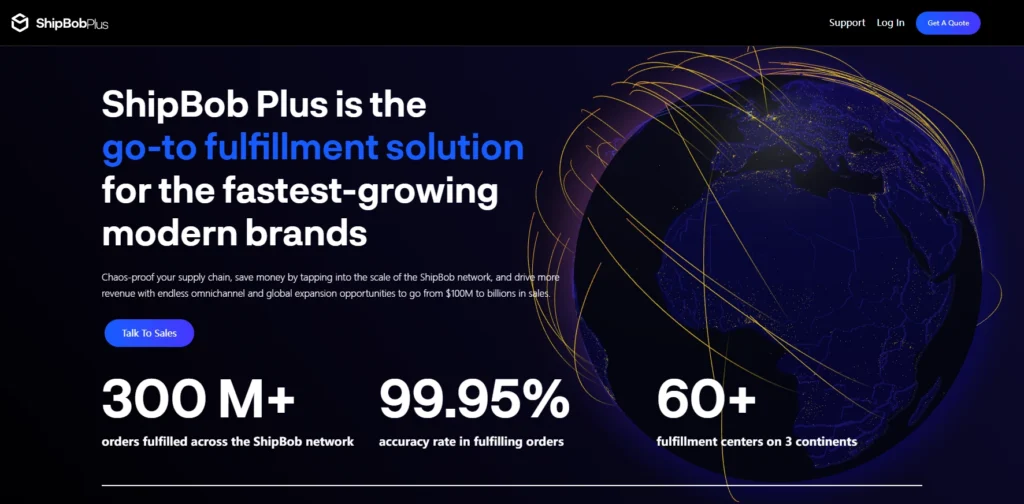
ShipBob’s strength lies in helping inventory-based ecommerce brands scale their fulfillment operations.
The company operates more than 60 fulfillment centers across North America, Europe, the United Kingdom, and Australia, allowing merchants to distribute inventory across multiple regions and reduce delivery times for customers. Combined with integrations for Shopify, WooCommerce, Amazon, Walmart Marketplace, TikTok Shop, and other ecommerce platforms, ShipBob provides a highly automated fulfillment environment once products are already in stock.
For established brands, the value proposition is straightforward. Instead of leasing warehouse space, hiring staff, and managing inventory across multiple locations, merchants can leverage ShipBob’s infrastructure to handle storage, picking, packing, shipping, inventory management, and retail distribution.
This becomes especially attractive once a business reaches predictable sales volume. Faster delivery, lower shipping costs, and distributed inventory can significantly improve customer experience and operational efficiency.
However, ShipBob’s role begins after inventory already exists.
The platform does not source products, negotiate with manufacturers, perform factory audits, manage supplier relationships, or oversee product development. Merchants remain responsible for building and maintaining their supply chain before inventory enters the warehouse.
For some brands, that’s perfectly fine. They already have reliable suppliers and simply need a better way to fulfill orders.
For others, fulfillment isn’t the biggest challenge.
Why Some Sellers Start Looking for a ShipBob Alternative
Most merchants searching for a ShipBob alternative are not questioning ShipBob’s ability to ship orders.
They’re questioning whether fulfillment is the primary bottleneck in their business.
For early-stage brands, cost is often the first consideration. Publicly available pricing information and industry reviews suggest that onboarding fees, monthly minimums, storage costs, receiving fees, and fulfillment charges can become meaningful expenses, particularly for businesses still testing products or operating at relatively low order volume.
These costs are easier to justify when a brand ships thousands of orders every month. They can feel much heavier when demand is still being validated.
But the bigger issue is usually economics rather than fulfillment.
Consider a simple example. A merchant sourcing a product through a marketplace supplier may pay $12 per unit. The same product sourced directly from a factory might cost $7 or $8. Reducing product cost by several dollars often improves profitability more dramatically than reducing shipping time by one or two days.
Experienced ecommerce operators understand this intuitively. Logistics optimization matters, but supply chain optimization usually comes first. Better sourcing creates margin. Margin funds growth.
Supplier-related issues further complicate the picture. Product defects, packaging inconsistencies, stock shortages, production delays, and quality control failures all occur before inventory reaches a fulfillment center. Even the most sophisticated warehouse network cannot solve problems that originate at the manufacturing level.
This is often the moment when sellers realize they may not need a different warehouse. They may need a different supply chain.
The Comparison Most Sellers Get Wrong
One reason the ShipBob discussion becomes confusing is that many merchants compare it with businesses that serve a completely different role.
ShipBob is fundamentally a logistics platform.
Ship To The Moon operates as a sourcing and fulfillment partner.
The distinction may sound subtle, but it changes almost everything.
A typical ShipBob workflow looks like this: Factory → Merchant → ShipBob Warehouse → Customer
The merchant is responsible for supplier selection, product sourcing, quality control, packaging decisions, inventory purchasing, and production management before inventory is sent to a ShipBob facility.
A Ship To The Moon workflow often begins much earlier: Factory → Sourcing & Supplier Management → Quality Control → Branding → Fulfillment → Customer
In this model, the service provider participates throughout the supply chain rather than only at the fulfillment stage.
For brands trying to improve margins, develop private-label products, customize packaging, or transition from basic dropshipping to a more defensible business model, that difference can be significant.
Viewed through this lens, the comparison becomes less about which company is better and more about which business problem needs solving first.
Ship To The Moon vs ShipBob
| Items | Ship To The Moon | ShipBob |
|---|---|---|
| Business Model | Supply chain service provider + sourcing agent + fulfillment partner | Global 3PL fulfillment platform |
| Core Positioning | End-to-end sourcing, fulfillment, branding, and logistics | Inventory storage, order fulfillment, and distribution |
| Integration & Automation | Shopify, WooCommerce, Etsy, custom API integration; automatic order routing, inventory sync, tracking updates | Shopify, WooCommerce, Amazon, Walmart, TikTok Shop, BigCommerce, etc. |
| Product Sourcing | Product catalog + private supplier network + agent sourcing; supports custom sourcing, sample development, winning-product sourcing | Not provided; merchants must source products independently |
| Product Price | Factory-direct pricing; generally lower sourcing cost and higher margin potential | Product cost depends entirely on merchant’s suppliers |
| MOQ Requirements | No MOQ for most dropshipping products; supports gradual scaling | No product MOQ, but fulfillment minimums and onboarding thresholds may apply |
| Fulfillment Model | Private supply chain + China fulfillment + overseas warehouse fulfillment | Distributed inventory across global fulfillment centers |
| Warehouse Network | China warehouses + US warehouses + EU warehouses + supplier network | 60+ fulfillment centers across North America, Europe, UK, and Australia |
| Order Consolidation | Supports consolidation and combined packaging through centralized fulfillment operations | Supports multi-item order fulfillment from stocked inventory |
| Shipping Speed (US) | 5–9 business days from China warehouses | Typically 2–5 days from domestic fulfillment centers |
| Shipping Speed (Global) | 6–12 business days to major markets | Fast local delivery through regional warehouse distribution |
| Custom Branding | Custom packaging, logo printing, inserts, thank-you cards, private label support | Custom packaging available through kitting and branded packaging programs |
| Private Label Capability | Strong; suitable for building branded ecommerce businesses | Limited; primarily fulfillment execution |
| Print on Demand | Supported through sourcing network and manufacturing partners | Not a core offering |
| Product Customization | Product modification, packaging customization, logo application, ODM/OEM support | Packaging-level customization only |
| Quality Inspection | Dedicated QC inspection before shipment | Generally no product-level sourcing QC |
| Pricing Model | No monthly subscription; pay per order or customized fulfillment quote | Multiple fulfillment fees including storage, pick & pack, receiving, returns, and shipping fees |
| Upfront Cost | Low; no mandatory software subscription | Setup fees may apply for larger merchants; onboarding fees can start around $975 for Growth accounts |
| Minimum Monthly Spend | None | Monthly fulfillment minimums apply after grace period (e.g. US: $275/month) |
| Hidden Costs | Pricing discussed upfront; generally transparent service-based pricing | Additional receiving, storage, kitting, oversized item, and handling fees may apply |
| Customer Support | Dedicated 1-on-1 account manager and sourcing support | Support varies by account tier; larger merchants often receive dedicated account management |
| Best For | Medium-to-advanced sellers, scaling brands, private-label businesses, higher-margin ecommerce operations | Established brands with predictable inventory and larger fulfillment volumes |
Which Platform Makes More Sense at Different Growth Stages?
One of the most common mistakes in ecommerce is adopting infrastructure designed for a later stage of growth.
The fulfillment strategy that works for a seven-figure brand is rarely the same strategy that works for a store still validating product-market fit.
During the product-testing phase, flexibility is usually more important than warehouse speed. Merchants are experimenting with products, testing advertising channels, and trying to identify winning offers. Committing large amounts of inventory to a fulfillment network can introduce unnecessary risk before demand is proven.
As a business begins scaling, margins become increasingly important. Advertising costs rise, competition intensifies, and customer acquisition becomes more expensive. At this stage, direct factory sourcing, quality control, private labeling, and custom packaging often create more value than incremental shipping improvements.
Once a brand reaches consistent sales volume and demand becomes predictable, fulfillment infrastructure starts playing a larger role. Inventory distribution, domestic warehousing, and faster delivery can improve both operational efficiency and customer experience. This is where ShipBob’s strengths become particularly relevant.
Interestingly, many mature ecommerce brands eventually combine both approaches. Products are sourced, customized, and quality-checked through a sourcing partner before inventory is shipped in bulk to domestic warehouses for local fulfillment. Rather than replacing one another, sourcing partners and fulfillment providers often become complementary parts of a larger supply chain strategy.
Is Ship To The Moon a Good ShipBob Alternative?
The answer depends entirely on what challenge you’re trying to solve.
If your business already has reliable suppliers, established inventory forecasting, and predictable demand, ShipBob remains one of the strongest fulfillment providers available. Its warehouse network, automation capabilities, and retail distribution infrastructure are designed for exactly that environment.
However, many ecommerce businesses searching for a ShipBob alternative are facing different challenges. They are trying to reduce sourcing costs, improve product quality, build a private-label brand, launch custom products, or move beyond the limitations of marketplace suppliers.
For those merchants, optimizing the supply chain often delivers greater returns than optimizing fulfillment alone.
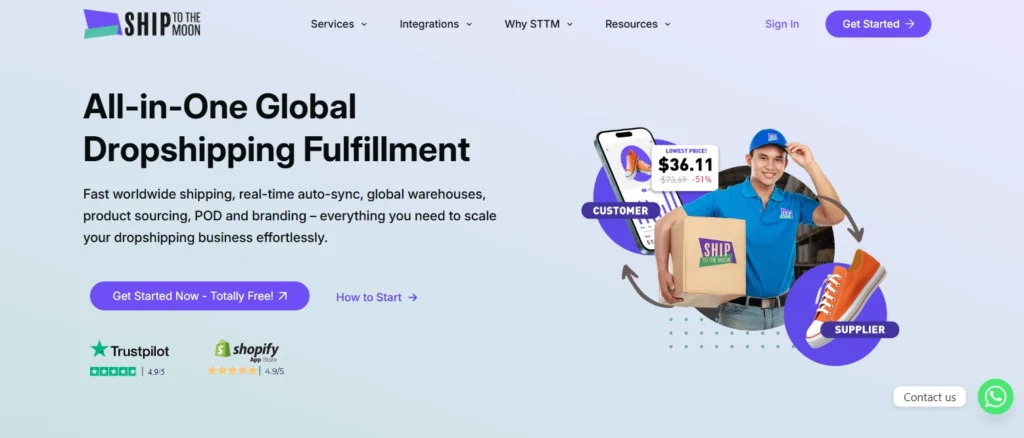
This is where Ship To The Moon fits naturally. By combining sourcing, supplier management, quality control, branding support, and fulfillment under one operational model, it helps merchants address the parts of ecommerce that traditional 3PL providers were never designed to handle.
Final Thoughts
ShipBob and Ship To The Moon are often compared, but they are not direct substitutes in the traditional sense.
ShipBob is a fulfillment infrastructure company. It excels at helping inventory-based brands store products, distribute inventory, and deliver orders efficiently across multiple markets.
Ship To The Moon operates further upstream. It helps merchants source products, manage suppliers, improve margins, customize products, build brands, and fulfill orders through a flexible supply chain network.
For brands whose biggest challenge is faster delivery, ShipBob is an excellent solution.
For brands whose biggest challenge is finding reliable suppliers, improving profitability, maintaining quality control, and building a scalable ecommerce operation without taking on excessive inventory risk, Ship To The Moon solves a different—and often earlier—set of problems.
The most successful ecommerce operators eventually recognize that fulfillment and supply chain management are not the same thing. Understanding where your current bottleneck exists is the key to choosing the right partner.